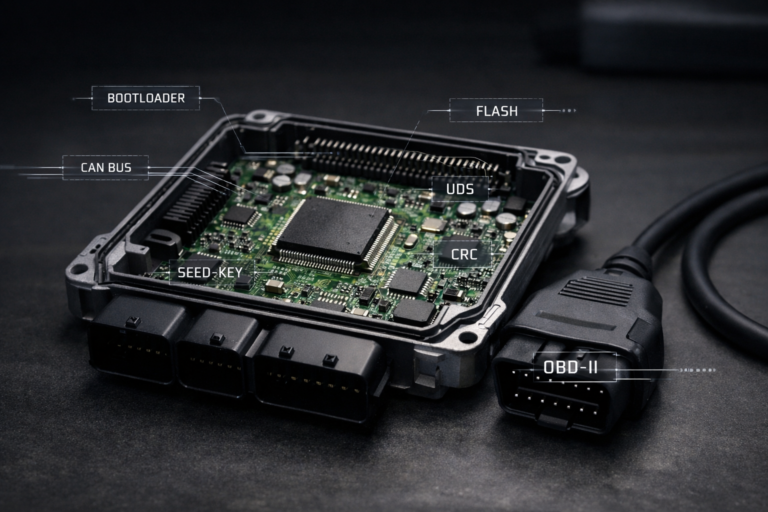
How Professional ECU & TCU Tuning Tools Actually Work
At the core, all professional tuning tools exist for one purpose: establishing reliable communication with a vehicle’s control units to safely read, modify, and write software. While this sounds simple in theory, the reality is far more complex.
Each ECU or TCU is built around specific processors, security layers, memory layouts, and communication protocols. These vary not only between manufacturers, but also between model years, engine revisions, and even software versions within the same vehicle.
Professional tuning tools act as translators. They must correctly identify the control unit, negotiate security access, manage checksums, handle voltage sensitivity, and ensure data integrity throughout the entire read/write process. A failure at any stage can lead to corrupted software or a non-responsive ECU.
To achieve this, tools rely on three primary access methods, each with its own risks, requirements, and use cases. Understanding when and how to use these methods is what separates professional tuning from trial-and-error flashing.
OBD (On-Board Diagnostics)
OBD access is the most common and user-friendly method in professional tuning. The tool connects through the factory diagnostic port, allowing software operations without removing any hardware from the vehicle.
For supported ECUs, OBD offers clear advantages:
- fast turnaround
- minimal labor
- lower physical risk
- customer-friendly workflow
However, OBD access is also the most restricted by manufacturers. As ECU security increases, many newer vehicles limit or completely block OBD writing. Some allow reading only, while others require online authorization, unlock procedures, or gateway bypasses.
A professional tuner must understand that OBD convenience always comes second to ECU security. When OBD is available, it’s ideal. When it’s not, forcing it is never an option.
Bench Mode
Bench mode removes the ECU from the vehicle and connects it directly to the tuning tool on a workbench. This bypasses some vehicle-level security and allows deeper access than OBD in many cases.
Bench mode is commonly used when:
OBD writing is locked
the ECU is partially protected
recovery is needed after a failed write
cloning operations are required
While bench mode offers more flexibility, it introduces new responsibilities. ECU removal must be done correctly, pinouts must be accurate, and stable power supply is critical. A mistake here can damage hardware, not just software.
Professional shops treat bench mode as standard practice—not a last resort—but only when they have the right tools and experience.
Boot Mode
Boot mode is the deepest level of ECU access available in professional tuning. It requires opening the ECU housing and directly interfacing with the processor on the circuit board.
This method allows:
- full memory access
- bypassing high-level security
- recovery of locked or damaged ECUs
- complete cloning and restoration
Boot mode is powerful, but unforgiving. It demands precision, correct grounding, correct boot pin handling, and complete understanding of the ECU architecture. This is not an entry-level operation.
A shop that can confidently perform boot mode work is no longer just tuning—they are doing ECU engineering.
The Risk of Running a Single Tuning Tool
Running a single tuning tool may work in the early stages of a business, but it creates hidden risks that grow over time.
At first, coverage looks sufficient. Jobs come in, vehicles are supported, and everything feels manageable. The problems only appear when the workflow expands—and by then, the damage is already happening.
A one-tool setup creates dependency. Your business becomes tied to one manufacturer’s update schedule, one support team, and one set of limitations. When that tool hits a wall, your entire operation hits it too.
Limited Vehicle Compatibility
No tuning tool excels across every brand, ECU family, and vehicle type. Some tools focus heavily on European passenger cars. Others prioritize trucks, agricultural machinery, or motorcycles.
When a customer arrives with a vehicle your tool cannot handle, the result is immediate:
- lost job
- lost revenue
- lost credibility
Professional workshops cannot afford to turn away work simply because of tool limitations. Every refused job is a competitor’s opportunity.
Delayed Protocol Releases
New ECUs and software versions appear constantly. Manufacturers release updates at different speeds, and no tool provider is first every time.
If your only tool hasn’t released support yet, you wait.
Your customer doesn’t.
Competitors with multiple tools simply switch platforms and take the job. Over time, this delay costs far more than the price of an additional tool.
Zero Redundancy
A single tool means a single point of failure.
If that tool:
- crashes mid-write
- requires an emergency update
- encounters license issues
- experiences server downtime
your workshop stops completely.
Professional businesses require redundancy. Downtime doesn’t just cost money—it damages trust.
Why Professional Tuners Always Own More Than One Tool
Multi-tool setups are not about excess.
They are about control.
Professionals don’t want to be limited by one ecosystem. They want options.
Multiple tools allow tuners to:
- adapt instantly
- choose the safest method
- continue working even when one platform fails
This flexibility is what keeps professional shops operational under pressure.
Expanded Vehicle Coverage = More Sales
Each additional tool expands your market reach.
With multiple tools, a shop can confidently handle:
- modern passenger cars
- older ECUs
- TCUs and gearboxes
- commercial vehicles
- agricultural and industrial machines
More coverage equals more billable work—and fewer excuses.
Choosing the Right Tool for the Job
Every tool has strengths and weaknesses. Some are fast. Some are stable. Some excel in TCU work. Others dominate ECU recovery.
Owning multiple tools allows you to choose the best tool for the ECU in front of you, not force a single tool into situations it wasn’t designed for.
This choice reduces risk and improves consistency.
Business Risk Reduction
When one tool fails, a professional doesn’t cancel the job.
They switch tools.
This is the line between:
- hobbyist tuning
- professional operations
Redundancy protects income, reputation, and customer confidence.
Why “One Tool Does Everything” Is a Myth
Tool manufacturers prioritize different areas:
- ECU depth vs TCU coverage
- modern vs legacy platforms
- speed vs flexibility
- cars vs heavy-duty applications
No single tool can dominate every category.
Professionals understand this. That’s why they build ecosystems—not dependencies.
Building a Real-World Professional Tuning Setup
In real workshops, success usually comes from balance.
Most established shops operate with:
one primary all-round tool
one modern ECU specialist
one advanced bench / recovery / TCU platform
These tools support each other, not compete.
The result is smoother workflow, higher acceptance rate, and better margins.
Tools Alone Are Not Enough: Skill & Support Matter
Hardware does not tune vehicles.
People do.
True professional results come from understanding:
- ECU behavior
- protection levels
- calibration logic
- recovery procedures
Even the best tool is useless without proper files and support. That’s why experienced shops partner with reliable master-level providers.
Master vs Slave Tools (Quick Explanation)
Slave tools offer a controlled, lower-risk environment. They’re ideal for shops focused on installation, customer service, and volume work.
Master tools offer full control, but also full responsibility. They require deeper technical knowledge and carry higher risk.
Most professional workshops use both, depending on job complexity and workload.
Not All Supported Vehicles Mean Equal Stability
“Supported” does not mean “safe.”
Some tools technically support an ECU but struggle under real-world conditions. Voltage sensitivity, write stability, and error handling vary greatly between platforms.
Stability matters as much as coverage—sometimes more.
This is why experienced tuners value predictable tools and avoid forcing risky operations.
EagleTuning: Multi-Tool Expertise with Competitive Slave Pricing
EagleTuning operates at the master level across all major tuning platforms. This allows us to support real-world multi-tool workflows instead of pushing a single ecosystem.
We provide:
- consistent file quality
- cross-platform support
- competitive slave pricing
- flexible solutions for mixed environments
This gives professional shops freedom without unnecessary risk or cost.
One Final Warning: Avoid Clone Tools
Clone tools are not savings.
They are liabilities.
- They compromise:
- software integrity
- hardware safety
- customer trust
One failed job can cost more than a genuine tool—and damage your reputation permanently.
Professional shops use genuine equipment. Always.