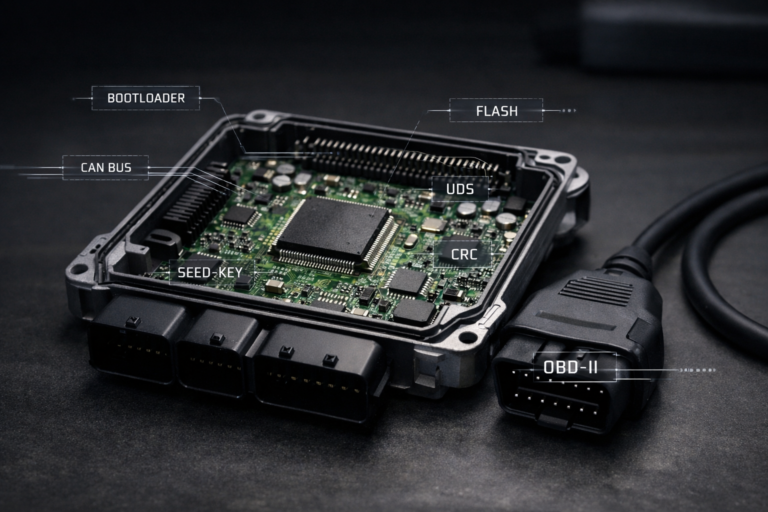
What Is ECU Tuning? (The Real Meaning Beyond “More Power”)
When most people hear the word tuning, they immediately think about one thing: more horsepower. Louder exhaust, faster acceleration, bigger numbers. While power is certainly a visible result, it is not the true definition of ECU tuning.
ECU tuning is the process of recalibrating the engine control unit’s internal logic to change how the engine behaves under different operating conditions. It is software engineering applied to thermodynamics, fluid dynamics, combustion physics, and mechanical limits. The horsepower gain is simply a side effect of doing this correctly.
Inside every modern vehicle, the Engine Control Unit is constantly making thousands of decisions per second. It determines how much fuel to inject, when to ignite the mixture, how much boost pressure to request from the turbocharger, how to control throttle angle, how to manage torque limits, how to protect components from overheating, and how to meet emissions and fuel economy targets. These decisions are not random. They are defined by hundreds of calibration maps designed by the manufacturer for a global compromise.
That compromise is the key.
A vehicle is not calibrated for maximum performance. It is calibrated to survive bad fuel quality, extreme climates, long service intervals, emissions regulations, noise regulations, different altitudes, inexperienced drivers, warranty constraints, and production tolerances across thousands of engines. The factory file must work for everyone, everywhere, under every condition. That means it is intentionally conservative.
ECU tuning removes that global compromise and replaces it with a specific calibration for a specific vehicle, in a specific environment, for a specific purpose.
This is where real tuning begins.
At its core, tuning modifies how the ECU interprets load, torque demand, boost control, fuel delivery, and ignition timing. These are not independent parameters. They are deeply linked through torque models, driver wish maps, air mass calculations, lambda targets, and protection strategies. A professional calibration does not simply “raise boost” or “add fuel.” It rebalances the entire system so the engine operates closer to its true mechanical capability while remaining safe.
For example, when a driver presses the accelerator pedal, they are not directly opening the throttle or commanding more boost. They are sending a torque request. The ECU calculates how much air mass is needed to produce that torque, how much boost is required to achieve that air mass, how much fuel is needed to maintain the desired lambda, and what ignition timing will create efficient combustion without knock. This entire chain is controlled by calibration data.
Tuning changes this chain.
This is why ECU tuning is often misunderstood by those who see it as a simple modification. In reality, it is closer to rewriting the engine’s behavior model.
A well-calibrated engine after tuning does not feel “modified.” It feels how the car should have come from the factory if there were no compromises. Throttle response becomes more natural. Torque delivery becomes smoother and earlier in the rev range. Gear changes feel more decisive. Turbo lag is reduced not by forcing the turbo harder, but by optimizing how and when torque is requested.
Another critical aspect is efficiency. Contrary to popular belief, a properly tuned engine can often become more fuel efficient during normal driving. This happens because the engine reaches target torque with less throttle input and operates in more efficient load regions instead of struggling in restricted factory torque zones.
ECU tuning is also about removing artificial limitations. Many modern vehicles contain torque limiters in lower gears, throttle closures at high load, delayed boost requests, and soft response curves designed for comfort and emissions compliance rather than performance. These are software decisions, not mechanical limitations.
Through calibration, these artificial behaviors are corrected.
This is why two cars with identical engines can feel completely different after proper tuning. The hardware has not changed. Only the logic controlling it has.
Professional tuning also respects the safety systems built into the ECU. Temperature protection, knock control, lambda monitoring, exhaust gas protection, and component protection strategies remain active. The goal is not to disable safety, but to recalibrate performance within those safe boundaries.
That is the difference between real ECU calibration and generic file flashing.
In the end, ECU tuning is not about chasing the highest dyno number. It is about creating a vehicle that responds better, drives smoother, delivers stronger torque, and operates closer to its mechanical potential without sacrificing reliability.
More power is simply the visible proof that the calibration is working.
That is the real meaning of ECU tuning.
How Modern ECUs Control the Engine (Why Tuning Is Even Possible)
To understand why ECU tuning works, you first have to understand how much control modern engine management systems actually have.
A modern Engine Control Unit is not a simple fuel computer. It is a real-time torque management system that models the entire engine in software. The ECU does not “react” to the engine. It predicts how the engine will behave based on mathematical models, sensor inputs, and calibration data.
This predictive nature is exactly why tuning is possible.
Older engines relied heavily on mechanical behavior. Throttle cable, mechanical wastegate control, fixed fuel pressure regulators, and basic ignition timing. Modern engines are the opposite. Almost every critical function is electronically controlled: electronic throttle body, electronically controlled wastegate or VGT, high-pressure direct injection, variable valve timing, torque-based transmission logic, electronic boost control, and dozens of sensors feeding constant feedback.
This means the engine is no longer governed by hardware limits first. It is governed by software decisions.
The ECU constantly receives data from sensors such as:
- Mass Air Flow (MAF) sensor or manifold pressure sensor (MAP)
- Intake air temperature sensor
- Coolant temperature sensor
- Wideband oxygen sensor (lambda)
- Knock sensors
- Fuel pressure sensor
- Camshaft and crankshaft position sensors
- Exhaust gas temperature models
- Throttle position sensor
- Accelerator pedal position sensor
Using this information, the ECU calculates the engine’s operating state hundreds of times per second.
But here is the part most people do not realize:
The ECU does not think in terms of boost, fuel, or timing.
It thinks in terms of **torque**.
When you press the accelerator, you are not requesting boost. You are requesting torque. The ECU then calculates how much air mass is required to produce that torque. From that air mass, it calculates how much boost pressure is needed. From the air mass, it calculates how much fuel must be injected to reach the desired lambda target. Then it calculates the ignition timing that will produce the most efficient combustion without causing knock.
All of this is controlled by calibration maps.
This torque-based architecture is the foundation of modern tuning.
Because everything is modeled, if you change the torque model, the ECU automatically changes how it commands boost, fuel, and timing. You are not directly telling the turbo to work harder. You are telling the ECU to allow more torque, and the ECU figures out the rest.
This is why professional tuning focuses heavily on:
- Driver wish maps (pedal to torque relationship)
- Torque limiters
- Air mass models
- Boost request maps
- Lambda target maps
- Ignition timing maps
- Component protection maps
- Temperature compensation maps
These are not independent tables. They are part of a single system.
For example, many factory calibrations limit torque in lower gears for comfort and traction control reasons. This is why a stock car often feels lazy in first and second gear. The engine is physically capable of producing more torque, but the ECU is not allowing it. The limitation is software, not hardware.
Tuning removes these artificial torque caps.
Another example is throttle behavior. In many vehicles, even at full pedal, the throttle plate may not open 100% at certain RPM ranges. The ECU closes it intentionally to manage emissions, noise, and fuel economy. This is why some cars feel “restricted” at high load. Proper calibration corrects this behavior.
Turbo control is also fully software-managed. The wastegate or variable vane turbo position is constantly adjusted by the ECU to meet a target air mass, not a fixed boost pressure. This is why raising boost in a professional calibration is not done by simply increasing a boost number. It is done by adjusting the air mass request and allowing the ECU’s boost control logic to achieve it safely.
Fuel delivery is equally advanced. Direct injection systems can control injection timing, injection duration, multi-pulse injection events, and fuel pressure. All of these are mapped. This allows tuners to optimize combustion efficiency far beyond what was possible in older engines.
Ignition timing is continuously adjusted by knock sensors. The ECU always tries to run the most advanced timing possible without causing detonation. Factory maps are conservative to handle poor fuel quality. When tuning for better fuel, these maps can be optimized significantly.
Modern ECUs also contain extensive protection systems. If intake temperatures rise too high, if exhaust gas temperature models exceed limits, if knock is detected, or if fuel pressure drops, the ECU reduces torque automatically. A good calibration respects these protections and recalibrates them rather than disabling them.
This is why tuning is not “forcing” the engine. It is **teaching the ECU new limits** within safe boundaries.
The reason tuning works so effectively is because manufacturers leave large safety margins in these models. Those margins are necessary for global reliability, but they are not necessary for a well-maintained vehicle running quality fuel in controlled conditions.
ECU tuning simply reduces those margins intelligently.
Without this software-centric engine management, tuning as we know it today would not exist. The reason a modern car can gain 20–30% more torque without changing a single hardware component is because the hardware was never the limitation.
The software was.
And that is why modern ECUs make professional tuning not only possible, but incredibly powerful when done correctly.
What Is Stage 1 Tuning?
Stage 1 tuning is the purest form of ECU calibration.
No hardware changes. No upgraded parts. No mechanical modifications. The engine, turbocharger, intercooler, exhaust system, fuel system, and intake remain completely stock. The only thing that changes is the software logic inside the Engine Control Unit.
And yet, the difference in how the car drives can be dramatic.
This is possible because, as explained earlier, modern engines are not limited by hardware first. They are limited by calibration decisions made by the manufacturer for global reliability, emissions compliance, fuel quality variation, and warranty safety margins.
Stage 1 tuning removes those conservative compromises while staying entirely within the safe operating range of the original hardware.
This is why Stage 1 is considered the safest and most balanced form of performance tuning when done correctly.
At the factory level, vehicles are intentionally calibrated with reduced torque in certain RPM ranges, delayed boost response, conservative ignition timing, rich lambda targets under load, throttle closures at high torque, and strict torque limiters in lower gears. These are not mechanical necessities. They are design choices.
Stage 1 calibration corrects these choices.
The first major change in a Stage 1 tune happens in the driver wish maps. These maps define how the accelerator pedal translates into torque demand. In many stock vehicles, 50% pedal does not mean 50% engine potential. It often means 30–35% torque request. This creates a soft, comfort-oriented driving feel.
After Stage 1, pedal input becomes more linear and more honest. The engine responds proportionally to the driver’s request.
Next comes the torque limiter structure. Modern ECUs contain multiple torque limiters: based on RPM, gear, temperature, atmospheric pressure, and component protection. Many of these limiters prevent the engine from delivering the torque it is physically capable of producing. Stage 1 recalibrates these limiters to match the real capability of the engine and turbocharger.
Then comes boost and air mass control. Instead of commanding higher boost blindly, Stage 1 increases the requested air mass in a controlled manner. The ECU’s existing boost control system handles the rest. This ensures stable, factory-like boost regulation without spikes or oscillations.
Fuel delivery is then optimized. Factory lambda targets under full load are often richer than necessary for safety reasons. Stage 1 leans these targets slightly while remaining within safe exhaust gas temperature limits. This improves combustion efficiency and torque output.
Ignition timing is another critical area. Manufacturers leave significant timing margins to accommodate poor fuel quality. With proper calibration for high-quality fuel, ignition timing can be advanced safely, producing more efficient combustion and more torque without increasing stress on the engine.
Throttle behavior is also corrected. In many stock files, the throttle plate closes partially at high RPM and load to control emissions and noise. Stage 1 allows the throttle to remain fully open when the driver demands power.
All of these changes work together. None of them are extreme individually, but collectively they transform how the engine behaves.
The result is not a car that feels modified. It feels unlocked.
Turbo lag is reduced. Mid-range torque increases significantly. The engine pulls harder and more smoothly. Gear shifts feel stronger because the transmission receives a more accurate torque model. The car becomes more responsive in daily driving, not just at full throttle.
One of the most surprising effects of Stage 1 tuning is improved drivability during normal use. Because the engine reaches desired torque with less throttle input, many drivers experience equal or even better fuel economy during regular driving.
Importantly, Stage 1 respects all factory hardware limitations. Turbocharger speed remains within safe range. Fuel system duty cycles remain safe. Exhaust gas temperatures remain controlled. Knock control and temperature protections remain active.
This is what separates professional Stage 1 calibration from aggressive generic files.
A proper Stage 1 tune does not “push” the engine. It allows the engine to operate closer to its true design capability.
This is why Stage 1 gains can be so impressive without changing any parts. On many modern turbocharged engines, gains of 20–30% in torque are common. Not because new stress is introduced, but because artificial restrictions are removed.
Stage 1 is ideal for drivers who want a significant improvement in performance without modifying the vehicle physically. No louder exhaust, no visible changes, no impact on daily usability. Just a car that drives the way it should have from the factory.
It is the foundation of professional ECU tuning and, for many vehicles, the most logical and balanced upgrade possible.
What Is Stage 2 Tuning?
If Stage 1 is about unlocking the potential of factory hardware, Stage 2 is about removing the physical restrictions that limit airflow.
An internal combustion engine is fundamentally an air pump. The more efficiently it can move air in and out, the more power it can produce. While Stage 1 optimizes the software controlling the engine, Stage 2 addresses the hardware components that physically restrict airflow — especially on turbocharged vehicles.
Stage 2 tuning typically requires specific supporting modifications, most commonly:
- High-flow or performance downpipe
- Upgraded intake system
- Sometimes a higher-efficiency intercooler
- Less restrictive exhaust components
These parts improve what tuners call the engine’s breathing ability.
The most critical component here is the downpipe. The factory downpipe contains a dense catalytic converter designed primarily for emissions compliance, not performance. While effective for reducing pollutants, it creates significant exhaust backpressure. This backpressure slows turbocharger spool, increases exhaust gas temperature, and limits how efficiently the turbo can move air.
Replacing it with a high-flow or performance downpipe dramatically reduces restriction.
You actually mentioned you currently have an AA catted downpipe installed — this is exactly the kind of modification that moves a car into Stage 2 territory. A high-flow catalytic converter maintains emissions functionality while allowing much better exhaust flow and lower temperatures. That cooler, freer exhaust stream lets the turbo operate more efficiently and safely at higher output levels.
But hardware alone does not create power.
Without recalibrating the Engine Control Unit, the ECU will still operate within its original airflow assumptions. In some cases, it may even reduce performance because sensor readings no longer match factory models.
This is why Stage 2 always requires a dedicated calibration.
With improved airflow, the engine can safely process more air mass. The Stage 2 tune increases torque requests further than Stage 1, allowing the turbocharger to generate higher sustained boost levels without excessive backpressure. Because exhaust temperatures drop with freer flow, the calibration can safely run more aggressive ignition timing and leaner lambda targets under load compared to Stage 1.
Another major difference is turbo efficiency.
At Stage 1, the turbo works harder against restrictive exhaust components. At Stage 2, the turbo operates in a more efficient region of its compressor map. This reduces shaft speed stress while still producing more airflow. In simple terms, the engine makes more power with less strain per unit of boost.
Intake upgrades also play an important role. A less restrictive intake reduces pressure drop before the turbo, allowing it to draw air more easily. This improves spool response and reduces compressor workload. While intake gains alone are usually small, they contribute significantly when combined with exhaust improvements.
Intercooler upgrades become relevant in hotter climates or repeated high-load conditions. Cooler intake air increases density, reduces knock tendency, and allows the ECU to maintain optimal ignition timing longer. This leads to more consistent performance rather than just higher peak numbers.
Stage 2 calibration also revises torque models more aggressively. Because airflow capability has increased, torque limiters can be raised further without exceeding safe exhaust gas temperature or turbo speed limits.
The driving experience changes noticeably compared to Stage 1.
Turbo spool becomes quicker. Mid-range acceleration becomes much stronger. High-RPM power continues pulling instead of tapering off. The engine feels less restricted and more eager across the entire rev range.
However, Stage 2 is not just about peak power. It is about sustained performance. Where Stage 1 might produce a strong surge that fades at higher RPM, Stage 2 maintains power delivery longer because the engine can breathe efficiently at higher airflow levels.
Sound characteristics also change. A performance downpipe deepens exhaust tone and increases turbo sound, though this is a byproduct rather than the goal.
Importantly, Stage 2 still uses the factory turbocharger and fuel system. This defines its upper limit. Eventually, the stock turbo reaches its efficiency ceiling, and pushing beyond that moves into Stage 3 territory.
A professionally calibrated Stage 2 setup maintains safety systems just like Stage 1. Temperature protections, knock control, fuel pressure monitoring, and component safeguards remain active. The goal is not to remove protections but to recalibrate them for the new airflow conditions.
Stage 2 is ideal for enthusiasts who want a clearly noticeable performance jump and are willing to install supporting hardware to achieve it. It represents the point where the vehicle begins transitioning from a mildly optimized daily driver into a true performance machine.
In simple terms:
Stage 1 unlocks the engine.
Stage 2 lets it breathe.
And that breathing is what allows the next level of performance to happen safely and consistently.
What Is Stage 3 Tuning? (Turbo, Fuel System, and Full Hardware Transformation)
Stage 3 tuning is where the vehicle stops being a lightly optimized factory car and becomes a fundamentally re-engineered performance machine.
At this level, the original limitations of the factory turbocharger, fuel system, and airflow capacity have been reached. No amount of software optimization or bolt-on airflow improvements can extract significantly more power because the core components themselves have become the bottleneck.
Stage 3 addresses those bottlenecks by replacing major hardware components.
This typically includes:
- Upgraded turbocharger or hybrid turbo
- High-pressure fuel system upgrades
- Larger injectors (on applicable platforms)
- Upgraded intercooler
- High-flow intake and exhaust system
- Sometimes internal engine reinforcement depending on platform
At this point, the vehicle’s performance capability is no longer defined by factory engineering decisions. It is defined by the mechanical limits of the new components and the quality of the calibration controlling them.
The stock Engine Control Unit was originally programmed around a specific turbo size, airflow range, and fuel delivery capacity. When those assumptions change drastically, the calibration must be redesigned much more deeply than in Stage 1 or Stage 2.
This is why Stage 3 tuning is not simply a “bigger Stage 2.”
It is a new operating model for the engine.
The upgraded turbocharger is the centerpiece. Larger turbos can move significantly more air mass, which means the engine can produce far more torque and horsepower. However, larger turbos also have different spool characteristics. They typically build boost later in the RPM range but continue producing power where smaller turbos would already be out of efficiency.
Calibration must reshape the torque curve to match this new behavior. Driver demand maps, boost control strategy, wastegate control, torque modeling, and load calculation all need adjustment so the car remains predictable and drivable.
Fuel system upgrades are equally critical. More air requires more fuel to maintain proper combustion ratios. Direct injection systems often need higher-capacity high-pressure pumps or additional fueling strategies. Without sufficient fuel delivery, the engine would run lean under load, which is dangerous.
Ignition timing strategies also change. Higher cylinder pressures increase knock tendency, so timing must be optimized carefully to produce power without causing detonation. This balance becomes more delicate as power levels rise.
Air temperature management becomes a major focus. Larger turbos generate more heat, and higher airflow compresses intake air more intensely. Upgraded intercoolers and revised temperature compensation maps ensure consistent performance and engine safety.
Stage 3 calibrations also involve revisiting every protection strategy in the ECU. Exhaust gas temperature models, turbo speed limits, fuel pressure safeguards, and component protection logic must all be recalibrated to match the new hardware’s capabilities. Disabling these protections would be reckless; adjusting them intelligently is what defines professional tuning.
Drivability becomes a major engineering challenge at this level.
A poorly calibrated Stage 3 car can feel unpredictable, laggy, or difficult to control. A properly calibrated one feels powerful yet manageable, with smooth torque delivery and predictable throttle response despite the massive increase in output.
Transmission behavior also becomes important. Modern transmissions rely on torque data from the ECU. If torque models are inaccurate, shifts can become harsh or inconsistent. Stage 3 tuning often includes transmission calibration to handle increased torque properly and maintain smooth operation.
Reliability now depends heavily on how the vehicle is used. While a well-built Stage 3 setup can be perfectly usable on the street, it operates closer to the mechanical limits of components. Maintenance, fuel quality, and monitoring become more important.
Unlike Stage 1 and Stage 2, Stage 3 builds are highly platform-specific. Some engines tolerate large power increases easily due to strong internal components. Others reach mechanical limits sooner and may require forged pistons, stronger connecting rods, or improved cooling systems to remain reliable.
This is why Stage 3 is not a universal formula. It is a custom engineering project tailored to the vehicle, the owner’s goals, and the intended use — street performance, track use, or competitive motorsport.
The driving experience at Stage 3 is transformative.
Acceleration becomes aggressive at speeds where the stock car would already be struggling. Power continues building instead of tapering off. The car feels less like a tuned production vehicle and more like a purpose-built performance machine.
But the goal of professional Stage 3 tuning is not chaos. It is controlled performance.
A properly engineered Stage 3 car should start smoothly, idle cleanly, cruise comfortably, and deliver extreme power only when requested. Achieving that balance requires deep understanding of both hardware and software.
In simple terms:
Stage 1 unlocks factory potential.
Stage 2 removes airflow restrictions.
Stage 3 replaces the limits entirely.
It is the point where tuning becomes true automotive engineering.
The Real Difference Between Stage 1, Stage 2, and Stage 3
The terms Stage 1, Stage 2, and Stage 3 are used everywhere in the tuning world, but they are often misunderstood. Many people assume the stages represent fixed power levels or universal upgrade packages. In reality, they describe how far the vehicle has moved away from factory configuration, both in hardware and calibration complexity.
The real difference between the stages is not just horsepower.
It is the relationship between software optimization, airflow capability, and mechanical limits.
Stage 1 operates entirely within factory hardware capability. The turbocharger, fuel system, cooling system, exhaust components, and intake remain stock. The ECU calibration is optimized to remove conservative factory limitations while respecting the original engineering margins.
At this level, the engine is still fundamentally the same machine the manufacturer designed. It simply operates closer to its true potential. Reliability remains very close to stock because no component is being pushed beyond what it was designed to handle.
Stage 2 changes that balance by modifying the engine’s airflow environment. The addition of high-flow exhaust components, improved intake systems, and sometimes intercooling upgrades allows the engine to move air more efficiently. The stock turbocharger remains, but it can now operate in a more favorable condition with less backpressure and lower temperatures.
The ECU calibration must adapt to this new airflow reality. Torque requests increase further, boost targets become more aggressive, and combustion optimization becomes more precise because the engine can sustain higher load safely.
Stage 3 crosses the line where factory hardware is no longer the defining limitation. Upgraded turbochargers, fuel system enhancements, and major airflow improvements transform the engine’s operating range. The calibration now manages a completely different performance envelope than the original design.
Another key difference lies in how the Engine Control Unit models torque.
Modern ECUs rely on accurate torque prediction for everything — throttle control, transmission behavior, traction systems, and safety protections. As modifications increase, the factory torque model becomes less accurate. Stage 1 requires minor adjustments. Stage 2 requires significant recalibration. Stage 3 often requires rebuilding the torque model entirely so the ECU understands the engine’s new capabilities.
Thermal management also evolves across stages.
At Stage 1, factory cooling systems are fully sufficient. At Stage 2, reduced exhaust backpressure often improves thermal conditions, even with higher output. At Stage 3, heat becomes a major engineering challenge due to higher airflow and sustained load. Intercoolers, oil cooling, and airflow management become critical to maintaining reliability.
The driving experience also changes differently than most people expect.
Stage 1 feels like a refined version of the stock car — smoother, stronger, more responsive, but still factory-like. Stage 2 feels noticeably more aggressive, with stronger mid-range acceleration and a freer-revving character. Stage 3 feels fundamentally different, with power delivery that can overwhelm traction and acceleration that continues far beyond factory expectations.
Importantly, the stages do not represent “good, better, best” in a universal sense.
For many drivers, Stage 1 is actually the optimal balance of performance, reliability, and daily usability. Stage 2 suits enthusiasts who want a more aggressive experience without fully transforming the vehicle. Stage 3 is for those seeking maximum performance and are willing to accept increased complexity and maintenance.
Another misconception is that each stage simply adds more boost. In professional tuning, boost pressure is only one variable among many. Air mass, fuel delivery, ignition timing, torque management, and temperature control are equally important. Two vehicles running identical boost levels can produce very different power depending on airflow efficiency and calibration quality.
Fuel quality also becomes increasingly important at higher stages. While Stage 1 can often adapt to varying fuel conditions, Stage 2 and especially Stage 3 calibrations may require consistent high-quality fuel to operate safely and optimally.
The stages also reflect increasing dependence on calibration precision. Minor errors in Stage 1 may go unnoticed. In Stage 3, calibration inaccuracies can lead to drivability issues or component stress. This is why advanced stages require extensive logging, testing, and refinement.
Ultimately, the progression from Stage 1 to Stage 3 is a journey from software optimization to full mechanical transformation.
Stage 1: Optimizing what the factory built.
Stage 2: Enhancing how the engine breathes.
Stage 3: Redefining the engine’s capability entirely.
Understanding this progression helps drivers choose the level that matches their goals rather than chasing the highest stage number.
Because in professional tuning, the best stage is not the highest one.
It is the one that fits the vehicle, the driver, and the intended use perfectly.
Why “Stages” Are Not Universal and Why Custom Tuning Matters
One of the biggest misconceptions in the performance world is the belief that Stage 1, Stage 2, and Stage 3 mean the same thing for every vehicle. In reality, these labels are not standardized engineering definitions. They are informal categories used by tuners to describe levels of modification relative to a specific platform.
What counts as Stage 2 on one car might barely qualify as Stage 1 on another.
The reason is simple: every engine, turbocharger, fuel system, and transmission is designed differently. Even within the same manufacturer, two engines with identical displacement can have completely different internal strength, airflow capability, and thermal tolerance.
A small turbocharged four-cylinder engine and a larger performance-oriented engine do not respond to modifications in the same way. Some factory turbos have large safety margins and can produce substantial gains with only software changes. Others operate near their efficiency limits from the factory and offer minimal headroom without hardware upgrades.
This is why stage terminology is only meaningful when tied to a specific platform.
Another major factor is regional variation. Vehicles sold in different markets often have different calibrations due to emissions laws, fuel quality, and environmental conditions. A Stage 1 tune developed for European fuel may behave differently on North American pump gas. Altitude, temperature, and humidity also influence engine performance and safe operating limits.
Even two identical cars can respond differently.
Manufacturing tolerances, wear, maintenance history, fuel quality, and environmental exposure all affect how an engine performs. A high-mileage engine may not tolerate the same calibration as a low-mileage one. Carbon buildup, injector condition, turbo wear, and cooling system efficiency all influence results.
This is where custom tuning becomes essential.
Generic files assume ideal conditions. They are designed to work on as many vehicles as possible without knowing the specific condition of each car. To remain safe across unknown variables, they must be conservative. As a result, they often leave performance on the table or fail to deliver smooth drivability.
A custom calibration tailored to a specific vehicle removes those assumptions.
Through logging and analysis, a professional tuner evaluates how the engine actually behaves: air mass flow, fuel pressure stability, ignition correction activity, temperature behavior, boost control accuracy, and many other parameters. The calibration is then adjusted to match the real-world data rather than theoretical expectations.
This approach is exactly what you emphasize at EagleTuning with log-based tuning and road dyno verification. Instead of applying a one-size-fits-all file, the calibration evolves based on the vehicle’s actual response. That is the difference between software installation and engineering.
The Engine Control Unit relies on accurate models to control torque, boost, and fuel delivery. When hardware modifications or environmental conditions change, those models must be recalibrated to maintain accuracy. Custom tuning ensures the ECU’s internal understanding matches reality.
Another reason stages are not universal is that supporting modifications vary widely. One Stage 2 build may include only a downpipe and intake, while another includes intercooling upgrades and fuel system enhancements. Both may be called Stage 2, but their capabilities differ significantly.
Driving goals also matter.
A vehicle tuned for daily street use requires different calibration priorities than one intended for track performance. Street cars benefit from smooth torque delivery and thermal stability in stop-and-go traffic. Track cars require sustained performance under continuous high load. The same stage label cannot capture these differences.
Transmission behavior adds another layer of complexity. Modern automatic and dual-clutch transmissions depend on accurate torque data from the ECU. If torque models are not recalibrated properly, shifts can become harsh, delayed, or inconsistent. Custom tuning ensures the engine and transmission operate as a coordinated system.
Safety margins are also platform-specific. Some engines tolerate high cylinder pressure due to strong internal components, while others are limited by piston design, connecting rod strength, or cooling capacity. A responsible tuner adjusts calibration targets accordingly instead of chasing identical numbers across different platforms.
Ultimately, stage terminology is a simplified way to communicate modification levels, not a precise technical classification.
What truly matters is the quality of the calibration and how well it matches the vehicle’s hardware, condition, environment, and intended use.
This is why professional tuners often focus less on stage labels and more on results: drivability, consistency, safety, and performance verified through data.
Because in real engineering terms, there is no universal Stage 1, Stage 2, or Stage 3.
There is only a calibration that is correct for that specific car — and one that isn’t.
Risks of Generic Files vs. Custom Calibration
As ECU tuning has become more popular, the market has been flooded with off-the-shelf (OTS) files promising quick power gains with minimal effort. These generic calibrations are designed to work on a wide range of vehicles without individual testing, logging, or adaptation.
While they may function adequately in some cases, they introduce risks that are often invisible until problems appear.
The core issue is that a generic file cannot know the condition of your specific vehicle.
It does not know:
- Fuel quality being used
- Actual airflow capability of the engine
- Health of the turbocharger
- Fuel system performance
- Injector condition
- Cooling system efficiency
- Carbon buildup level
- Sensor accuracy
- Environmental conditions
It assumes everything is ideal.
Modern engines operate within tight margins, especially under high load. Small variations in fuel quality, intake air temperature, or fuel pressure can significantly affect combustion stability. A generic calibration must either be conservative enough to survive worst-case conditions or aggressive enough to deliver impressive dyno numbers in ideal conditions. It cannot be perfectly optimized for both.
This is why some generic files feel inconsistent — strong in cool weather, weaker in heat, smooth on one car, rough on another.
The Engine Control Unit constantly adapts to sensor feedback, but adaptation has limits. If the calibration requests more airflow or torque than the hardware can safely deliver, the ECU’s protection systems intervene. This can cause throttle closures, timing pull, boost reduction, or erratic behavior that drivers interpret as inconsistency.
In more extreme cases, the ECU may not intervene quickly enough to prevent stress.
One of the most common risks is incorrect ignition timing for the fuel being used. Timing that is safe on high-octane fuel can cause knock on lower-quality fuel. Repeated knock events increase cylinder pressure stress and heat, which over time can damage components.
Fuel delivery assumptions are another risk. If the file expects fuel pressure that the system cannot maintain, the engine may run lean under load. Lean combustion raises exhaust gas temperatures dramatically and can damage pistons, valves, or turbochargers.
Boost control also varies between vehicles. Small differences in wastegate behavior or turbo wear can lead to higher-than-expected boost spikes when using a generic calibration. Excessive boost increases thermal and mechanical stress.
Generic files also cannot account for hardware variations within the same model year. Manufacturers often change components mid-production without changing the model name. A calibration developed on one version may not perfectly match another.
Drivability issues are common as well. Poorly calibrated torque models can confuse the transmission, leading to harsh shifts, delayed response, or inconsistent behavior. Throttle mapping may feel unnatural, making the car harder to control smoothly.
Custom calibration eliminates these uncertainties.
By analyzing real data from the vehicle — airflow, fuel pressure, ignition behavior, temperature trends, boost response — the tuner can adjust the calibration to match actual performance rather than theoretical assumptions. If the engine shows signs of stress, the calibration is refined. If the engine has additional headroom, performance can be increased safely.
This iterative process is what you already apply with log-based tuning and road dyno verification. Instead of guessing, the calibration evolves based on measurable results.
Custom tuning also ensures consistency. The car behaves predictably in different temperatures, driving conditions, and fuel qualities because the calibration has been validated against real-world data.
Reliability improves as well. Safety systems remain active and properly calibrated, allowing the ECU to protect the engine when necessary without unnecessarily reducing performance.
Another advantage is transparency. When tuning is based on data, both tuner and driver understand what the engine is doing and why adjustments are made. This builds confidence that the performance gains are sustainable, not temporary.
Generic files treat tuning as a product.
Custom calibration treats tuning as a process.
For drivers who want maximum performance with minimal risk, the difference is significant. The goal is not just to produce higher numbers but to ensure the engine operates smoothly, safely, and consistently over time.
In professional tuning, the best calibration is not the most aggressive one.
It is the one that delivers strong performance while maintaining control, stability, and reliability under real conditions.
How Professional Tuners Decide What Stage a Car Needs
Choosing the right stage for a vehicle is not about chasing the highest number or following a trend. A professional tuner evaluates the car as a complete system — mechanical condition, hardware configuration, intended use, and owner expectations — before recommending any level of modification.
The process starts with understanding the vehicle itself.
Mileage, maintenance history, previous modifications, and overall mechanical health all influence what the engine can safely handle. A low-mileage engine with excellent maintenance may tolerate more aggressive calibration than a high-mileage one with unknown history. Signs of wear such as turbo shaft play, weak fuel pressure, excessive knock activity, or cooling inefficiency can change the recommendation immediately.
This is why serious tuners never assume two identical cars will behave identically.
Next comes hardware inspection. The tuner identifies what components are stock and what has already been modified — intake, exhaust, intercooler, turbocharger, fuel system, transmission upgrades, and supporting hardware. For example, a vehicle with a high-flow downpipe and intake is already closer to Stage 2 territory, while a completely stock car is a clear Stage 1 candidate.
You mentioned earlier that your customers often arrive with partial modifications already installed. This is a common situation. Installing parts without matching calibration can create mismatches in airflow assumptions, making professional evaluation even more important.
After the physical inspection comes data analysis.
Using diagnostic tools and logging software, the tuner monitors how the engine behaves under real driving conditions. Parameters such as air mass flow, boost pressure stability, fuel pressure, ignition correction activity, intake air temperature, throttle behavior, and torque intervention events reveal the engine’s true operating condition.
This step is crucial because the Engine Control Unit makes decisions based on its internal models. If those models no longer match reality due to hardware changes or wear, the engine may not perform optimally or safely.
Log analysis shows where the headroom exists.
If airflow and fuel pressure remain stable with minimal ignition corrections, the engine likely has capacity for additional performance. If the ECU is already intervening with torque reductions or timing pull, pushing further would be counterproductive.
Driving goals are the next factor.
Not every driver wants the same experience. Some prioritize daily comfort and reliability. Others want aggressive acceleration for weekend driving or track use. A commuter vehicle operating in traffic-heavy environments benefits from smooth torque delivery and thermal stability. A performance-focused car may accept more aggressive response and higher operating temperatures.
Transmission type also matters. Manual transmissions allow more direct control but place stress on the clutch. Automatic and dual-clutch transmissions rely on accurate torque data and may require transmission calibration to handle increased output smoothly.
Environmental conditions influence recommendations as well. Vehicles operating in hot climates, high altitudes, or heavy traffic face different thermal challenges than those in cooler environments with open roads. Fuel availability is another constraint. Consistent access to high-quality fuel allows more advanced calibration than regions where fuel quality varies.
Budget and upgrade plans are also considered. Some owners want a gradual progression — starting with Stage 1 and moving upward later. Others prefer installing all hardware upgrades at once and calibrating for the final setup immediately.
A professional tuner aligns the stage recommendation with these plans to avoid unnecessary costs or redundant work.
Risk tolerance is part of the discussion too. Higher stages bring increased performance but also greater complexity and maintenance requirements. A responsible tuner explains these trade-offs clearly so the owner can make an informed decision.
Finally, the recommendation is validated through testing. Road dyno measurements, controlled acceleration runs, and real-world driving confirm that the chosen calibration delivers the expected results safely and consistently.
This methodical approach transforms tuning from guesswork into engineering.
The goal is not simply to maximize power. It is to create a vehicle that performs exactly as intended for its owner while maintaining reliability and drivability.
Sometimes the best decision is to stay at Stage 1. Sometimes Stage 2 offers the ideal balance. In other cases, a full Stage 3 build is justified.
What matters is not the stage label.
What matters is that the calibration matches the car, the environment, and the driver perfectly.
That is how professional tuners decide — not by numbers, but by understanding the machine as a whole.
Conclusion: Tuning Is Engineering, Not a Number
In the modern performance world, tuning is often reduced to simple labels and headline figures — Stage 1, Stage 2, Stage 3, horsepower gains, torque numbers, dyno charts. While these metrics are useful for comparison, they do not capture the true nature of what professional ECU calibration represents.
Tuning is not a number.
It is applied engineering.
Every internal combustion engine is a complex thermodynamic system controlled by software. Airflow dynamics, combustion efficiency, fuel atomization, ignition timing, thermal management, mechanical stress limits, and electronic control strategies all interact continuously. Changing one variable affects many others. A professional calibration accounts for these relationships rather than treating them as independent adjustments.
This is why serious tuning is closer to systems engineering than modification.
The Engine Control Unit is essentially the brain of the powertrain. It models engine behavior, predicts torque output, manages component protection, coordinates with the transmission, and adapts to environmental conditions in real time. Recalibrating it means reshaping how the entire vehicle behaves, not just increasing output.
At EagleTuning, this philosophy is already reflected in the emphasis on log-based tuning and road dyno verification. Instead of relying on theoretical gains or generic files, performance improvements are validated through real-world data. This ensures the calibration works not just in ideal conditions, but in the environments where the vehicle is actually driven.
Engineering-based tuning prioritizes balance.
Power without control is not performance. A car that produces impressive peak numbers but suffers from heat saturation, inconsistent behavior, or poor drivability is not properly engineered. True performance means repeatability — the ability to deliver strong results consistently without overstressing components.
This is why factory engineers leave safety margins in the first place. They design for worst-case conditions across global markets. Professional tuning narrows those margins intelligently, based on known conditions and monitored data, rather than removing them blindly.
Reliability and performance are not opposing goals when calibration is done correctly.
A well-tuned engine can operate more efficiently, respond more naturally, and deliver stronger torque while remaining within safe operating limits. Improved combustion efficiency can even reduce stress in certain scenarios because the engine achieves desired output with less wasted energy.
Another important aspect is driver experience.
Engineering-focused tuning does not aim to create a car that feels aggressive all the time. It aims to create a car that behaves exactly as the driver expects — calm during daily driving, responsive when requested, powerful under load, and stable across varying conditions. Smoothness, predictability, and control are just as important as peak output.
Stage labels, while convenient, should be seen as communication tools rather than performance goals. The optimal stage is the one that aligns with the vehicle’s hardware, condition, environment, and intended use.
For many drivers, a carefully engineered Stage 1 calibration provides the perfect balance. Others may benefit from Stage 2 airflow improvements. Enthusiasts seeking extreme performance may pursue Stage 3 builds. None of these choices are inherently superior. They simply represent different engineering solutions to different goals.
Professional tuning also respects the vehicle as a complete system. Engine calibration must work in harmony with the transmission, cooling system, traction control, and chassis capabilities. Increasing engine output without considering these factors creates imbalance rather than performance.
Ultimately, tuning done properly enhances what the manufacturer built rather than fighting against it.
It reveals the hidden potential within the engine while maintaining the safeguards that keep it reliable. It transforms the driving experience without compromising usability. It turns a mass-produced vehicle into something tailored to its owner.
That is why tuning should never be viewed as a shortcut to power.
It is a disciplined process of measurement, analysis, calibration, testing, and refinement — the same principles used in professional motorsport and advanced engineering fields.
Because in the end, real tuning is not about chasing the biggest number.
It is about understanding the machine, respecting its limits, and optimizing it with precision.
That is what turns software changes into true performance engineering.
Footnote:
The definitions of Stage 1, Stage 2, and Stage 3 used in this article represent the most commonly accepted and conservative boundaries in professional ECU tuning communities as of 2025–2026. However, exact stage classifications can vary slightly depending on the vehicle platform, manufacturer, regional emissions standards, tuner philosophy, and specific supporting modifications. For example:
- Some tuners classify a high-flow catted downpipe + intake + software optimization as “Stage 1+” or still within Stage 1 territory.
- On certain platforms (e.g., VW EA888, BMW B58, or Honda K20C), a downpipe alone may be considered sufficient to enter Stage 2.
- Transmission type, fuel quality expectations, climate, and intended use (daily vs. track) can also influence where a build falls between stages. These labels are informal guidelines rather than rigid engineering standards. Always consult with a professional tuner who can evaluate your specific vehicle through logging and real-world testing for the most accurate and safe recommendation.*