
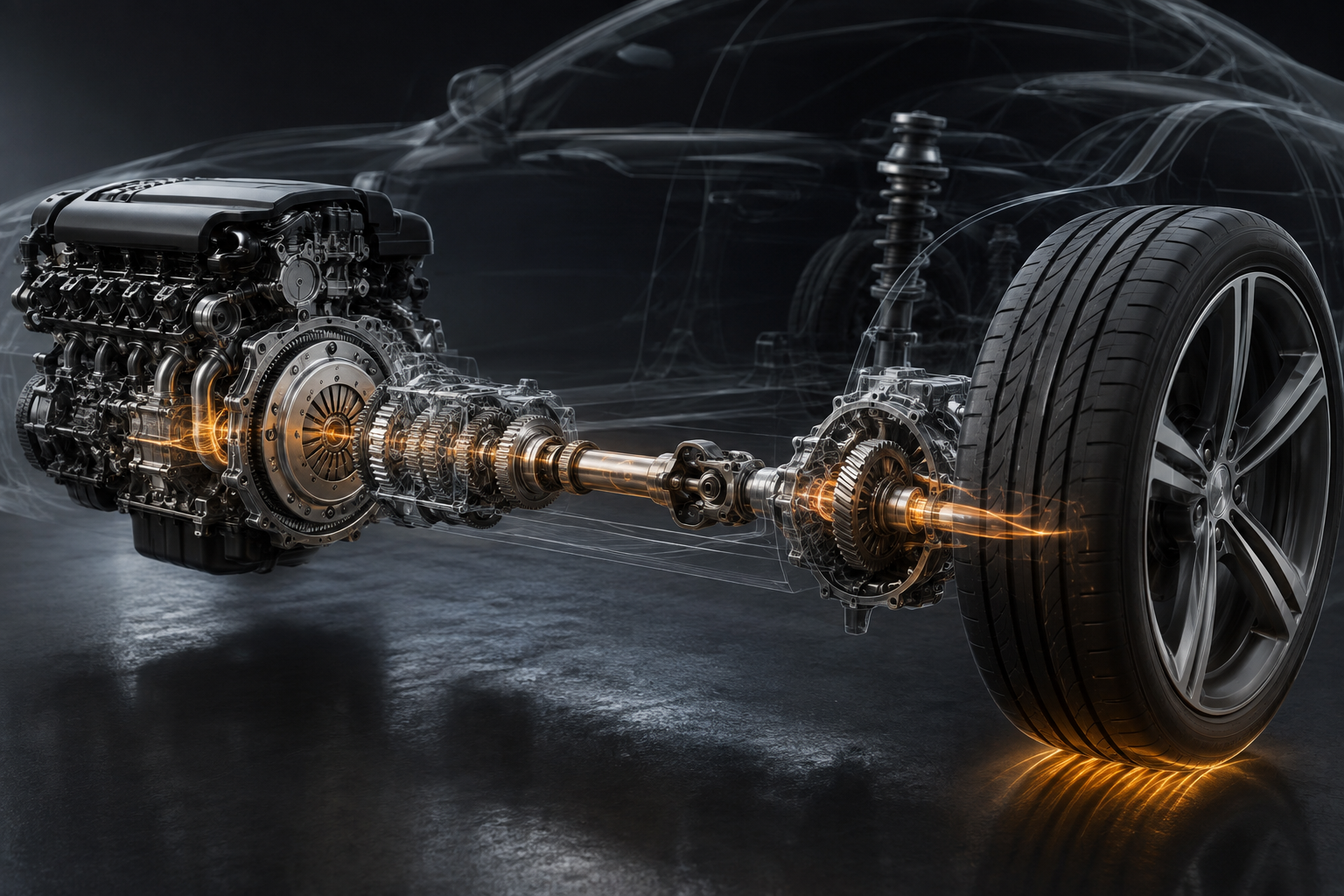
The Hidden Thief: Understanding Power Loss from Engine to Wheels
Every automotive enthusiast has experienced the moment of truth. You purchase a vehicle, enthusiastically read the manufacturer’s brochure that proudly advertises “200 Horsepower,” and later decide to put it on a chassis dynamometer to see what it can really do. The dyno operator straps the car down, runs it to the redline, and the screen displays a peak of 170 horsepower. Did the manufacturer lie to you? Is your engine broken? The answer to both is a resounding no.
Welcome to the complex and often misunderstood world of drivetrain power loss, technically known as parasitic loss. What you are witnessing is the fundamental difference between the power an engine makes in a vacuum and the power it can successfully deliver to the pavement[cite: 1]. In this deep dive, we are going to explore the highly technical journey of a unit of energy as it travels from the combustion chamber all the way to the tire’s contact patch.
Crank Horsepower (CHP) vs. Wheel Horsepower (WHP)
To understand the loss, we first have to understand the starting point. When an automaker designs an engine—let’s call it Engine Code ABC 123—they place it on an engine dyno[cite: 1]. This is a highly controlled environment where the engine is mounted on a test stand, completely removed from the car[cite: 1]. The power is measured directly at the crankshaft[cite: 1]. This measurement is known as Crank Horsepower (CHP) or Brake Horsepower (BHP). It represents the absolute maximum potential of the engine under ideal conditions, without the burden of moving a two-ton metal box.
However, once that engine is installed on the assembly line, its job becomes infinitely harder. To measure the power of an assembled car, enthusiasts use a chassis dynamometer[cite: 1]. A chassis dyno acts as an automotive treadmill[cite: 1]. The vehicle’s drive wheels are placed on massive, heavy rollers (drums)[cite: 1]. Modern dynos use complex eddy current systems to apply a calculated magnetic braking force against the wheels[cite: 1]. By measuring the torque required to spin these drums against the resistance, the dyno calculates the power actually making it to the ground[cite: 1]. This is your Wheel Horsepower (WHP)[cite: 1].
As a classic example, consider the legendary early generations of the Mazda MX-5 (NA and NB platforms with 1.6L and 1.8L engines)[cite: 1]. In the tuning community, it is a universally accepted piece of dyno-mathematics that if you want 100 WHP, your engine needs to be producing roughly 126 CHP[cite: 1]. That 26-horsepower discrepancy didn’t just vanish into thin air; it was consumed by the mechanical reality of the drivetrain[cite: 1].
The Anatomy of Parasitic Loss: Where Does the Power Go?
Power loss is not magic; it is pure physics[cite: 1]. Every single moving part between the engine’s crankshaft and the rubber on the road demands a “tax” to operate. This tax is paid in the form of friction, rotational inertia, and heat[cite: 1]. Let’s follow the path of the power and examine every toll booth along the way.
1. The Clutch and Flywheel Assembly
The journey begins the moment power leaves the engine’s crankshaft and meets the flywheel and clutch assembly[cite: 1]. These are heavy, metallic discs that must be spun. Overcoming their resting inertia requires energy. Furthermore, the act of the clutch engaging the transmission input shaft involves friction[cite: 1]. While a fully engaged clutch shouldn’t slip, the sheer rotational mass of these components inherently absorbs a fraction of the engine’s output before it even reaches the gearbox.
2. The Transmission (Gearbox) Friction
Once inside the transmission, the power is handed off to the input shaft bearing (often referred to as the pilot or input bearing)[cite: 1]. Bearings are highly efficient, but they are not frictionless[cite: 1]. As the input shaft turns, it engages a complex matrix of gears. These gears do not operate in dry air; they are bathed in thick, heavy transmission fluid or gear oil[cite: 1].
Imagine trying to run through waist-deep water versus running on dry land. The gears face a similar fluid resistance[cite: 1]. The constant churning, splashing, and shearing of the transmission oil creates immense friction[cite: 1]. The byproduct of this friction is heat[cite: 1]. If your transmission feels warm after a long drive, you are literally feeling the lost horsepower radiating as thermal energy.
3. The Driveshaft and Universal Joints
In a rear-wheel-drive (RWD) or all-wheel-drive (AWD) layout, the power must travel from the front-mounted transmission to the rear of the car via a long metal tube called a driveshaft. If the driveshaft were perfectly straight and infinitely rigid, losses would be minimal. But in the real world, the suspension moves, and components are mounted at slight angles[cite: 1].
To accommodate this, driveshafts utilize Universal Joints (U-joints)[cite: 1]. Inside these U-joints are tiny needle bearings packed tightly with dense grease[cite: 1]. Because the U-joints operate at a slight angle, these needle bearings are constantly rotating and shifting under immense torque loads[cite: 1]. Pushing through the thick grease and the mechanical angle deviation consumes a measurable chunk of kinetic energy[cite: 1].
4. The Differential (Ring and Pinion)
The power finally arrives at the rear axle, where it meets the differential. The differential’s primary job is to take the rotational force from the driveshaft (spinning along the length of the car) and turn it 90 degrees to spin the wheels. This is achieved using a ring and pinion gear set (ayna mahruti)[cite: 1].
This 90-degree transfer of power is inherently inefficient. The gear teeth slide against each other under massive pressure. To prevent them from destroying each other, the differential is filled with some of the thickest, heaviest gear oil in the entire vehicle (often 75W-90 or 80W-140 viscosity)[cite: 1]. Forcing the heavy ring gear to churn through this viscous sludge takes a tremendous amount of effort, resulting in one of the largest single points of power loss in the entire drivetrain[cite: 1].
5. Axles, Wheel Bearings, and Brakes
We are almost at the road, but the taxes aren’t finished. The power must travel down the heavy steel axles to the wheel hubs. The hubs spin on wheel bearings, which, once again, involve metal rollers packed in grease.
Finally, we have the braking system. It is a common misconception that when your foot is off the brake pedal, the brake pads are entirely clear of the brake rotors[cite: 1]. In reality, brake pads rest with a microscopic clearance against the rotors; they are practically kissing[cite: 1]. If you jack up a car and try to spin a wheel by hand, you won’t be able to spin it endlessly[cite: 1]. You will feel a distinct, heavy drag[cite: 1]. That drag is the residual friction of the brake pads and wheel bearings[cite: 1]. At 100 kilometers per hour, overcoming that drag requires real engine horsepower.
Drivetrain Layouts: FWD vs. RWD vs. AWD
Because every component adds friction, the layout of the drivetrain drastically alters the final WHP[cite: 1]. If we took the exact same engine and placed it in three different chassis, the dyno results would be wildly different[cite: 1].
- Front-Wheel Drive (FWD): FWD vehicles generally suffer the least amount of power loss (typically 10-15%)[cite: 1]. The transmission and differential are combined into a single unit (a transaxle) mounted directly adjacent to the engine. The path is short, there is no long driveshaft, and fewer directional changes for the power[cite: 1].
- Rear-Wheel Drive (RWD): RWD vehicles experience moderate losses (typically 15-20%)[cite: 1]. The power must travel through a separate transmission, down a driveshaft, through U-joints, into a separate heavy differential, and out through the axles.
- All-Wheel Drive (AWD): AWD vehicles suffer the most severe parasitic loss (often 20-25% or more)[cite: 1]. They utilize a transmission, a center differential or transfer case, two driveshafts, two separate differentials (front and rear), and four heavy axles. More moving parts inevitably equal more friction[cite: 1].
Dyno-Mathematics: The Viscosity Experiment
To truly understand how sensitive this system is, let’s look at a practical, real-world dyno experiment involving fluid viscosity[cite: 1]. Let’s take a standard 5-speed RWD car with a 2.0-liter engine[cite: 1].
The Baseline Run: We strap the unmodified car to the dyno. The ambient conditions are perfect. The car puts down exactly 100 WHP[cite: 1].
The Thick Oil Test: We pull the car off the dyno, drain the transmission and differential, and refill them with a significantly thicker, heavier gear oil—still within the manufacturer’s allowed specifications, but at the maximum viscosity end of the spectrum[cite: 1]. We do not change the engine, the fuel, or the air pressure. We strap the car back down. The dyno now reads 96 WHP[cite: 1].
We have literally lost 4 horsepower. Why? The engine is producing the exact same energy, but the internal resistance (parasitic drag) of the drivetrain components fighting through the thicker oil has increased[cite: 1]. That lost 4 horsepower was converted entirely into waste heat inside the gearbox and differential[cite: 1].
The Thin Synthetic Test: We drain the thick oil and replace it with an exotic, ultra-premium, ultra-low-friction, fully synthetic lightweight racing fluid[cite: 1]. We run the car again. The screen now flashes 104 WHP[cite: 1]. By drastically reducing the internal friction and fluid drag, we have “freed up” horsepower that was previously trapped in the drivetrain.
Real-World Consequences: Beyond the Dyno Sheet
This dyno-math translates directly to your daily commute. Consider the car from our experiment that dropped to 96 WHP due to excessive drivetrain drag. Imagine driving that car for 100,000 kilometers[cite: 1].
If you are driving up a steep hill side-by-side with an identically matched car that has an optimized 104 WHP drivetrain, your car will struggle more[cite: 1]. To maintain the exact same speed as the optimized car, you will have to press the accelerator pedal deeper[cite: 1]. Your engine ECU will command larger fuel injector pulses. You will burn more fuel, generate more heat, and subject your engine to greater internal wear simply to overcome the internal friction of your own transmission and axles[cite: 1].
Modern engine control units (ECUs) are incredibly smart. They communicate with the drivetrain via traction control systems[cite: 1]. If you apply too much power on a slippery surface and the tires lose their grip, the ECU recognizes the rotational speed mismatch[cite: 1]. It doesn’t just apply the brakes; it aggressively pulls ignition timing, cuts the electronic throttle plate, and drastically reduces engine output to regain traction[cite: 1]. This shows that raw engine power is entirely useless if the drivetrain and tires cannot efficiently manage its transfer to the ground.
Conclusion
The next time you look at a car’s spec sheet, remember that the advertised horsepower is a theoretical maximum—a best-case scenario of an engine isolated from the real world. True performance is dictated by the efficiency of the entire mechanical orchestra. Power loss from the engine to the wheels is unavoidable, but by understanding the mechanics of the clutch, the transmission, the driveshaft, and the differential, we can appreciate the immense engineering required to make a vehicle move[cite: 1]. Keep your fluids fresh, choose the right viscosities, and remember that sometimes, the best way to make a car faster isn’t to add more power, but to stop losing the power you already have.