
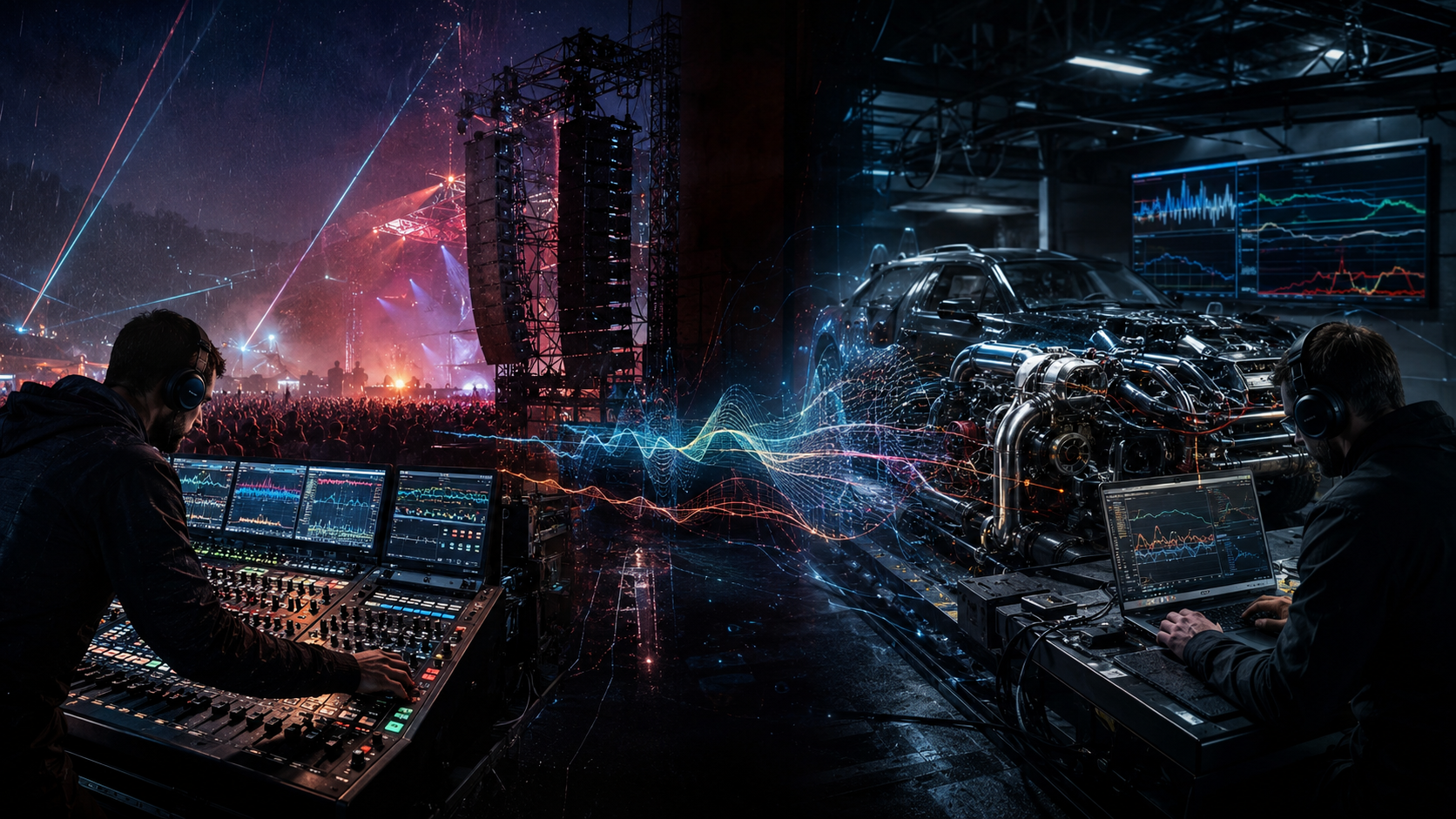
Isomorphic Engineering: The Mathematics of Disaster and Delivery at 130dB
The rain had just started to mist over the massive open-air arena in Brussels. 50,000 people were packed shoulder-to-shoulder, waiting for the climax of Tiësto’s set. Standing near the Front of House (FOH) mixing desk, I could feel the sheer acoustic pressure vibrating through my ribs. But while the crowd was captivated by the lasers and the man on stage, my eyes were glued to the FOH sound engineer.
Suddenly, the telemetry on his screen flashed a vicious red. Tiësto was pushing the pioneer mixer to its absolute threshold, demanding more from the system right as a massive sub-bass build-up began. One of the primary amplifier racks powering the left line array was rapidly approaching its thermal limit. If it tripped, half the stadium would go dead silent exactly when the drop hit. It would be a catastrophic failure.
The engineer didn’t panic. With less than three seconds to the drop, his fingers flew across the digital console. He engaged a dynamic multi-band compressor, surgically cutting a few decibels at $60\text{Hz}$ to relieve the thermal load on the failing amp, while simultaneously tweaking the phase alignment of the delay towers to artificially boost the perceived low-end for the crowd. The drop hit with earth-shattering force. The crowd lost their minds. The rig survived. And nobody except him—and me, watching over his shoulder—knew how close we had just come to disaster.
Watching him operate in that chaotic, high-stakes environment, a profound realization hit me: structurally, mathematically, and emotionally, we do the exact same job.
At Eagle Tuning, I don’t mix audio. For the last fifteen years, I have been rewriting the operational software of Engine Control Units (ECUs) and Transmission Control Units (TCUs) for high-performance vehicles. One discipline governs acoustics and voltage; the other governs thermodynamics and fluid dynamics. Yet, strip away the hardware, and both roles are fundamentally about calibrating closed-loop control systems to operate at the absolute ragged edge of their physical limits—and pulling them back milliseconds before they self-destruct.
Here is a technical breakdown of how mixing a massive EDM festival and calibrating a high-performance engine are mathematically isomorphic.
1. The Threshold of Catastrophe: THD vs. Knock (Detonation)
In live audio, DJs frequently push their outputs to the maximum. If an audio signal exceeds the voltage rails of an amplifier, the peaks of the sine wave are violently clipped off, turning into square waves. This induces extreme Total Harmonic Distortion (THD).
$$ THD = \frac{\sqrt{V_2^2 + V_3^2 + \dots + V_n^2}}{V_1} \times 100 $$
Where $V_1$ is the fundamental frequency amplitude, and $V_n$ are the harmonic amplitudes.
A clipped square wave sends massive, continuous RMS power to the speaker voice coils, generating excess heat that will literally melt the hardware within seconds. To prevent this, the FOH engineer implements brick-wall limiters—algorithmic safety nets that compress the signal ratio the millisecond it crosses a dangerous decibel threshold.
In my world, our equivalent to audio clipping is engine knock, or detonation. Picture a BMW B58 engine strapped to my dyno, screaming at 7,000 RPM. When I request massive boost pressure from the turbocharger, cylinder pressure ($P_{cyl}$) and temperatures skyrocket. If the air-fuel mixture auto-ignites even a microsecond before the spark plug fires, colliding flame fronts create massive pressure spikes that will bend forged connecting rods and shatter pistons. The onset of this catastrophe is modeled using the Livengood-Wu auto-ignition integral:
$$ \int_{t_0}^{t_e} \frac{1}{\tau(T, P)} dt = 1 $$
Just as the sound engineer relies on DSP limiters, I rely on knock control algorithms. The ECU detects detonation using a knock sensor—a piezoelectric microphone tuned to specific acoustic frequencies (usually between $6\text{kHz}$ and $9\text{kHz}$). When the “audio” of the engine block spikes in that frequency, my software instantly pulls ignition timing, saving a $15,000 engine from turning into shrapnel.
2. Phase Coherence and Time Alignment
In a stadium in Brussels, sound from the main stage takes time to travel. If you have delay towers 100 meters back and all speakers fire simultaneously, the sound from the stage will hit the crowd in the back completely out of phase with the local speakers. This creates destructive interference (comb filtering), effectively canceling out the bass.
The engineer must calculate precise time delays based on the speed of sound, which fluctuates in real-time as the rain cools the air temperature ($T$ in Celsius):
$$ c \approx 331.4 + 0.6T \text{ (m/s)} $$
$$ \Delta t = \frac{d}{c} $$
By applying a microsecond delay ($\Delta t$), the acoustic wavefronts align perfectly in the air, creating a massive wall of sound.
In the engine block, I battle time alignment constantly, though we call it Ignition Advance. A flame front inside a cylinder takes a fixed amount of time to burn. At 7,000 RPM, the piston is moving so incredibly fast that I must start the spark before the piston even reaches the top of its stroke. My mathematical target is to time the explosion so that Maximum Brake Torque (MBT) hits the piston at exactly $8^\circ$ to $10^\circ$ After Top Dead Center (ATDC).
$$ t_{spark} = \frac{\theta_{advance}}{6 \times RPM} $$
If the FOH engineer misses their phase alignment, the crowd gets a weak bass drop. If I miss my phase alignment by just two degrees, the engine either loses fifty horsepower instantly or dumps burning fuel straight into the turbine, melting the exhaust manifold.
3. Taming the Chaos: Closed-Loop PID Control
Neither a sprawling outdoor EDM festival nor a screaming internal combustion engine exists in a vacuum. They are highly chaotic, rapidly changing environments. Static maps are useless.
We both rely heavily on Proportional-Integral-Derivative (PID) controllers to maintain order in the chaos.
$$ u(t) = K_p e(t) + K_i \int_{0}^{t} e(\tau) d\tau + K_d \frac{de(t)}{dt} $$
The sound engineer uses multiband compressors acting as PID loops, constantly analyzing acoustic feedback and auto-adjusting to the changing density of a sweaty, jumping crowd. I spend hours calibrating the PID gains ($K_p$, $K_i$, $K_d$) for electronic wastegate control (WGDC). If my Proportional gain is too aggressive, the turbo violently overshoots its target and goes into limp mode. We tune the math so the turbo spools with terrifying violence but stops exactly at the target pressure, whether you are driving at sea level or high in the mountains.
The Art Behind the Code
Engineers often get siloed into their specific disciplines—software, acoustics, mechanical. But at a foundational level, physics is universal, and so is the adrenaline.
Whether you are standing behind a massive digital mixing console saving a million-dollar audio rig from a thermal meltdown, or sitting in the driver’s seat analyzing datalogs at wide-open throttle to save a built engine from detonating, the pursuit is identical. We manage dynamic variables. We process real-time telemetry. We dance on the absolute edge of disaster.
We do all of this in the shadows, writing code and tweaking formulas, for one singular purpose: to engineer an absolutely flawless, visceral, unforgettable human experience.