1. Gasoline Begins as a Mixture, Not a Single Molecule
Crude oil contains a wide range of hydrocarbons: compounds built mainly from hydrogen and carbon. Those molecules differ in size, shape, boiling behavior, and chemical reactivity. Crude also contains sulfur compounds and other materials that require treatment. Gasoline is one selected and processed part of this much larger chemical inventory. It consists of many molecules rather than one fixed chemical substance, and its composition can vary while still meeting the same finished-fuel specification. Calling gasoline “octane” therefore confuses a commercial mixture with both a family of molecules and a performance rating.
The distinction between molecular formula and molecular structure is central to fuel chemistry. Two molecules can contain the same numbers of carbon and hydrogen atoms but connect those atoms differently. These structural isomers can behave quite differently during the chemical reactions that precede autoignition. In broad terms, many straight-chain paraffins have relatively poor knock resistance, while suitable branched paraffins provide better resistance. This is a useful trend rather than a rule that predicts every fuel. Carbon number, ring structure, unsaturation, temperature, pressure, and interactions between components all affect the final behavior of a blend.
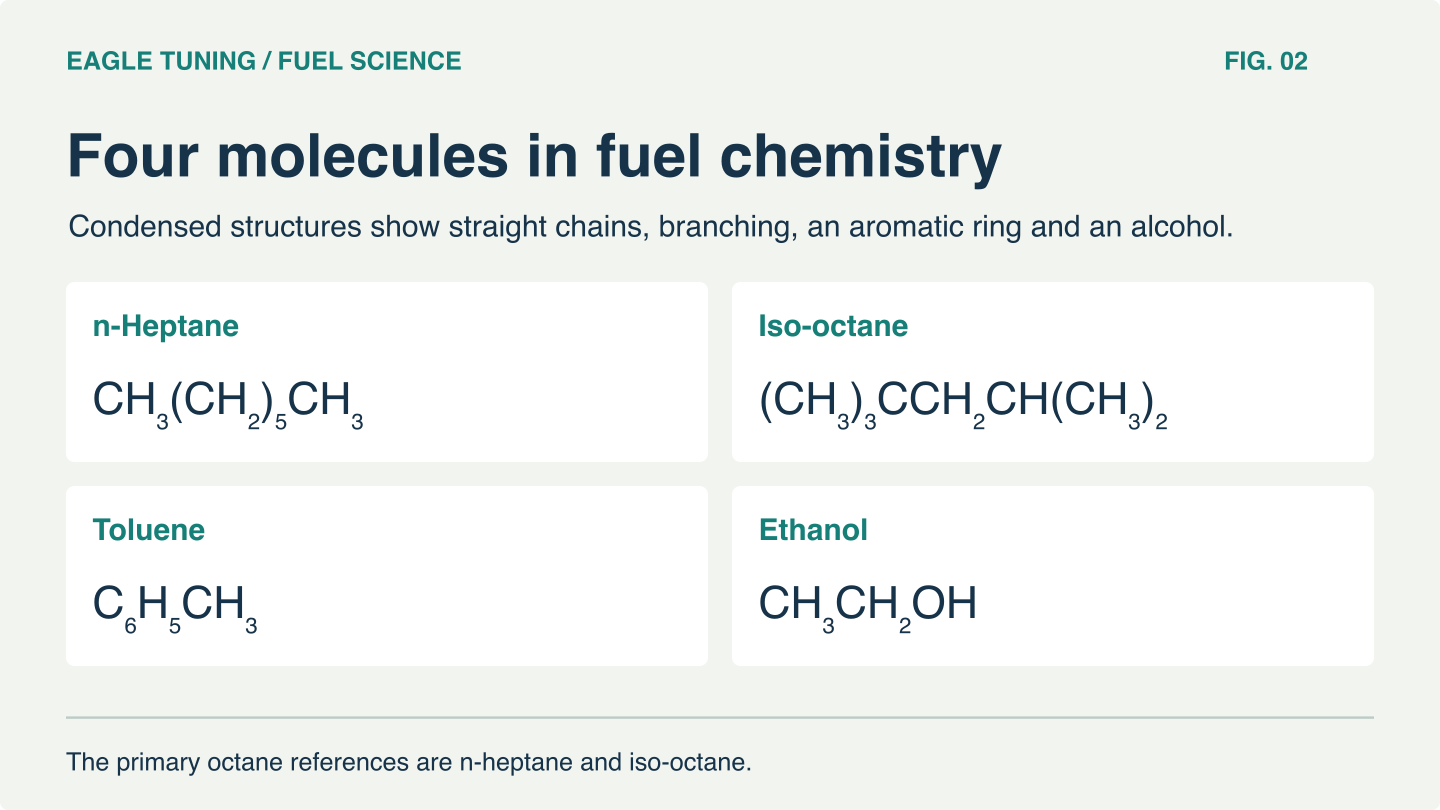
The classic reference molecules illustrate the principle. Normal heptane, usually written n-heptane, is a straight-chain hydrocarbon with the formula C7H16. Iso-octane, specifically 2,2,4-trimethylpentane, is a branched C8H18 molecule. On the conventional primary-reference-fuel scale, n-heptane is assigned an octane number of zero and iso-octane a value of 100. Those assigned values describe their behavior in standardized knock testing. They do not mean that heptane contains no energy or that iso-octane contains the maximum energy a fuel can release. Both are combustible liquids; their resistance to unwanted autoignition is what separates them in this context.
The word “octane” also needs careful handling. In chemistry, octane can refer to C8H18 hydrocarbons, including straight-chain n-octane and its branched isomers. In a fuel specification, an octane number is a measured performance characteristic. These uses are related historically but are not interchangeable. A gasoline rated 93 AKI does not need to contain 93 percent of any octane molecule. Nor does a gasoline containing more eight-carbon molecules necessarily have a higher rating. The laboratory result depends on how the complete mixture behaves, not on a count of carbon atoms or the concentration of one named ingredient.
Other hydrocarbon families add more possibilities. Aromatics contain ring structures with delocalized electrons; toluene is a familiar example. Many aromatic blending components offer useful knock resistance, but they also influence density, volatility, combustion products, and emissions. Olefins contain carbon-carbon double bonds and may contribute octane while creating other stability and specification considerations. Cycloparaffins contain saturated rings and respond differently again. A refiner cannot maximize one favorable property without considering the others. A gasoline that resists knock but evaporates poorly during starting, forms excessive deposits, or fails emissions requirements is not a successful road-fuel formulation.
Ethanol adds another category because it contains oxygen as well as carbon and hydrogen. Its formula, C2H5OH, identifies an alcohol rather than a hydrocarbon. Adding it changes more than the octane number: the blend’s energy per unit volume, air requirement, water tolerance, volatility behavior, and evaporative cooling can all change. A modern premium fuel may therefore obtain its knock resistance through a combination of branched hydrocarbons, aromatic components, ethanol, and other approved blendstocks. There is no single universal recipe called “premium,” even where the octane label on competing pumps is identical.
2. How a Refinery Builds Finished Gasoline
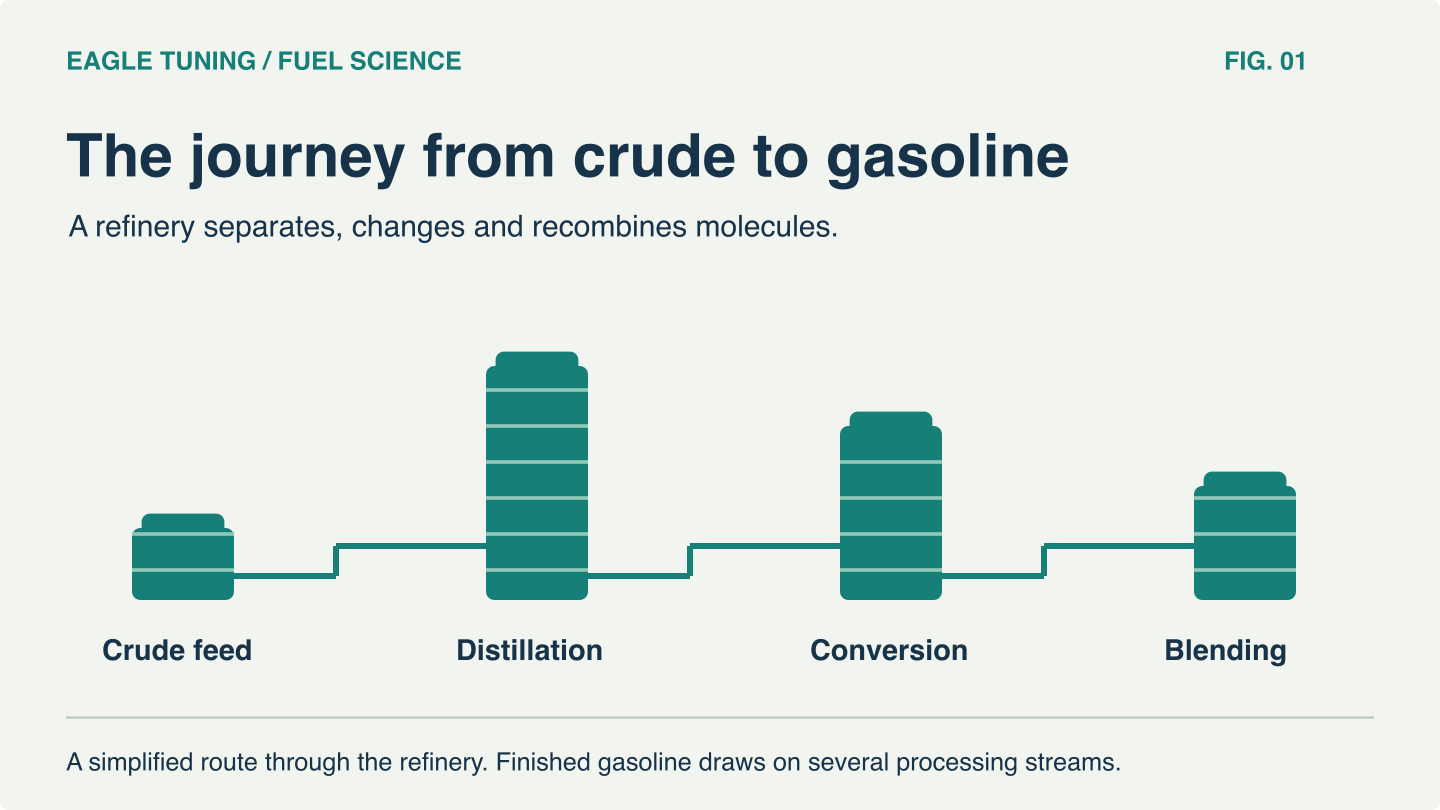
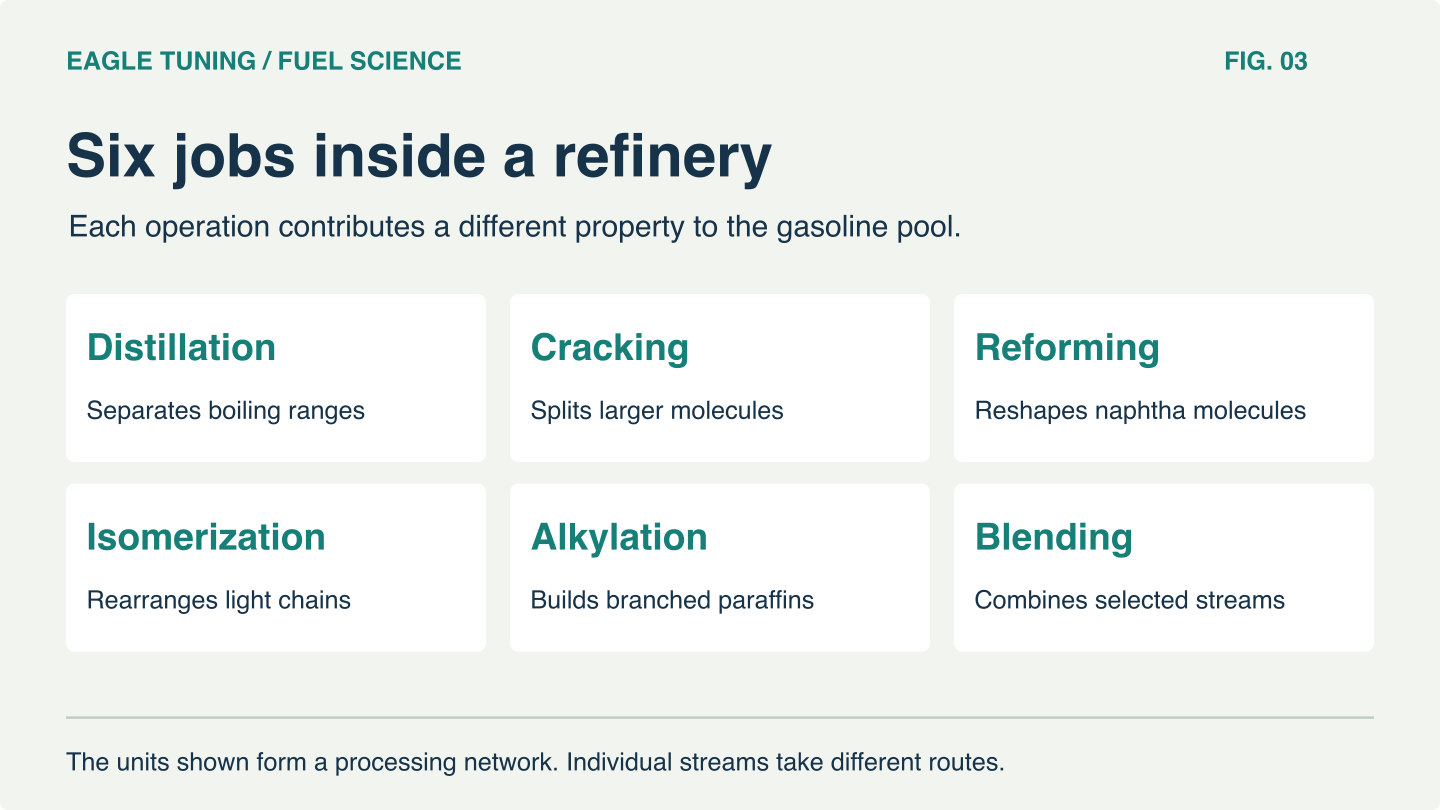
A refinery does not simply filter crude oil until premium gasoline comes out. Its first major job is separation. Heated crude enters a distillation system in which components are separated into fractions according to boiling behavior. Lighter fractions rise farther through the atmospheric column, while heavier material is withdrawn lower down or sent for additional processing. A gasoline-range fraction can be obtained this way, but straight-run material alone generally cannot satisfy the quantity and quality demanded of modern gasoline. Distillation separates molecules that already exist; the conversion units alter the molecular inventory available for blending. The EIA’s refinery overview describes this progression from separation to conversion and finished products.
Catalytic cracking is one route from heavier material to useful lighter products. Large hydrocarbon molecules are broken into smaller molecules with a catalyst under controlled conditions. Fluid catalytic cracking produces gasoline-range material along with lighter gases and other products. Hydrocracking also converts heavier feedstocks, but uses hydrogen and a different processing environment. These units help the refinery turn a barrel of crude into a product mix that better matches demand. Neither process should be imagined as a machine that makes one pure grade of gasoline ready for immediate retail sale; their outputs are intermediate streams with characteristics the blender must understand.
Catalytic reforming serves a different purpose. Rather than mainly reducing molecular size, it changes the structure of suitable naphtha molecules, producing a higher-octane reformate stream and valuable hydrogen. Reactions can form aromatic rings and rearrange molecules, improving the stream’s usefulness in the gasoline pool. The hydrogen can support treatment elsewhere in the refinery. Reforming therefore links fuel quality with the wider processing system. However, a refiner cannot simply fill every premium tank with reformate: limits on benzene and other composition or emissions characteristics, together with volatility and economic constraints, require a balanced final blend.
Isomerization provides another way to improve knock resistance. By rearranging selected light straight-chain hydrocarbons into more favorable branched structures, the refinery can upgrade their usefulness without relying on the same aromatic chemistry as reforming. Alkylation adds a further option, combining selected light hydrocarbons to make a stream rich in valuable branched paraffins. Alkylate is attractive because it can offer high knock resistance with low aromatic and olefin content. These different streams give fuel formulators several tools, each with its own cost, availability, boiling range, and contribution to the finished product.
Treatment is just as important as conversion. Sulfur removal helps produce fuel suitable for modern emissions systems, and other processing steps improve stability or remove undesirable components. Some treatment operations can affect octane, creating another tradeoff for the refinery to manage. A finished fuel must satisfy a collection of requirements rather than one laboratory number: knock resistance, sulfur limits, vapor pressure, distillation behavior, oxidation stability, and composition restrictions all matter. Meeting them together is an engineering exercise. The pump label is a concise description of one outcome, not a complete report of the manufacturing process.
Blending brings the streams together. A refinery or terminal may combine different proportions of reformate, alkylate, isomerate, cracked gasoline components, suitable light hydrocarbons, and other permitted materials. Where ethanol is added downstream, the hydrocarbon blendstock is designed with that later addition in mind. This is why a sample of gasoline blendstock before ethanol addition may not meet the final pump-grade octane requirement on its own. It was never intended to be the finished retail product. Evaluating the base gasoline separately and concluding that the final fuel has been diluted reverses the actual formulation strategy.
Volatility shows why this balancing work matters to an engine. Gasoline must vaporize sufficiently for reliable starting and combustion, yet excessive volatility can increase evaporative losses and create hot-fuel handling problems. Vapor pressure describes one aspect of this behavior, while a distillation curve shows how much of the fuel evaporates as temperature rises. Two fuels with the same octane number can have different distillation curves. That difference may influence cold starting, transient fueling, mixture preparation, and operation after a hot soak. Octane alone does not describe any of those characteristics.
Season and location can change the recipe. A fuel formulated for winter starting may differ from a summer blend designed to limit evaporation, and regional requirements may call for different formulations. None of this implies that the octane rating is arbitrary; it means the rating coexists with other requirements. The same brand and grade can legitimately change composition during the year while maintaining its labeled antiknock quality. The EIA’s gasoline overview explains that gasoline formulations vary by region and season. For a tuner, repeatable fuel supply means understanding these variables rather than assuming a familiar logo guarantees an identical chemical mixture every month.
3. What Octane Measures Inside a Running Engine
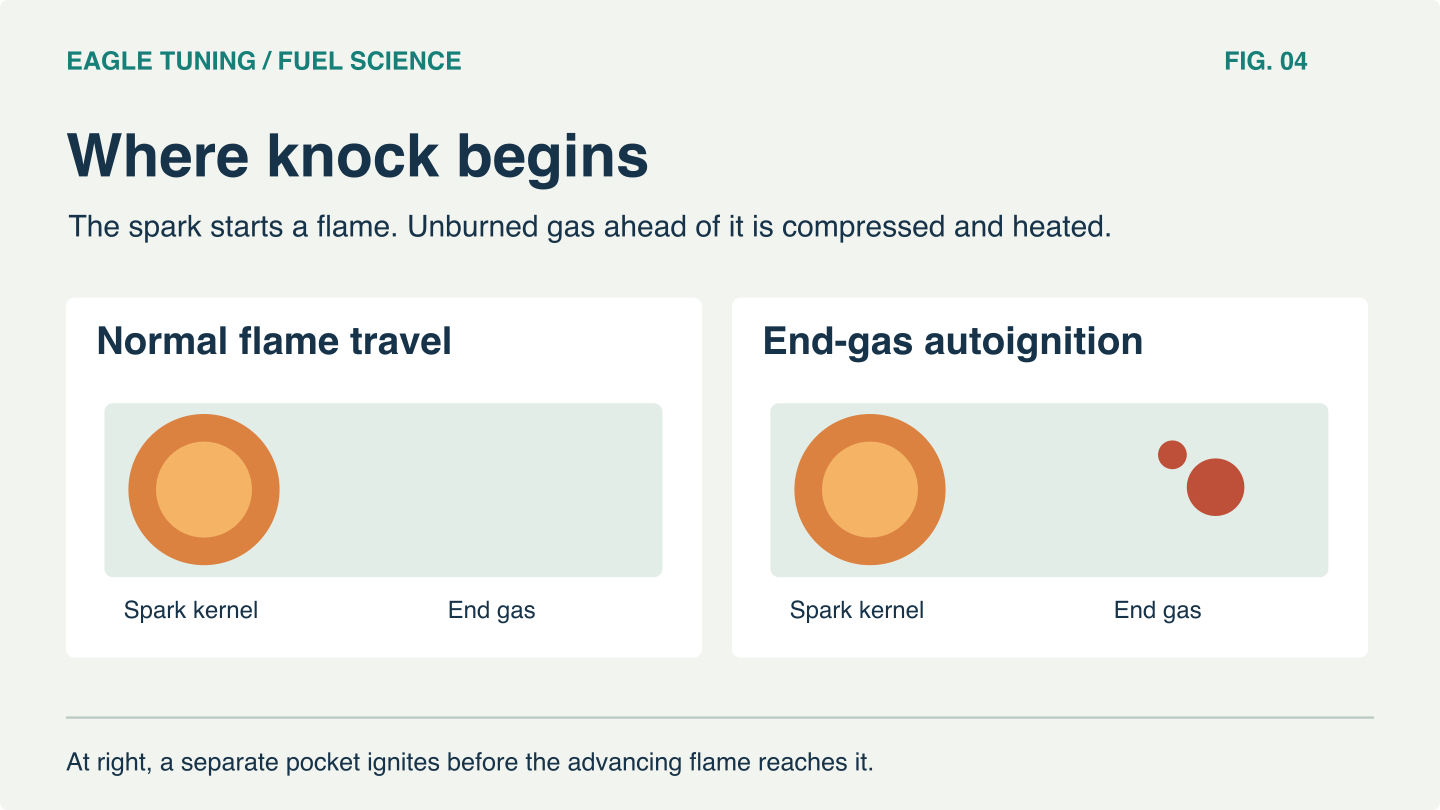
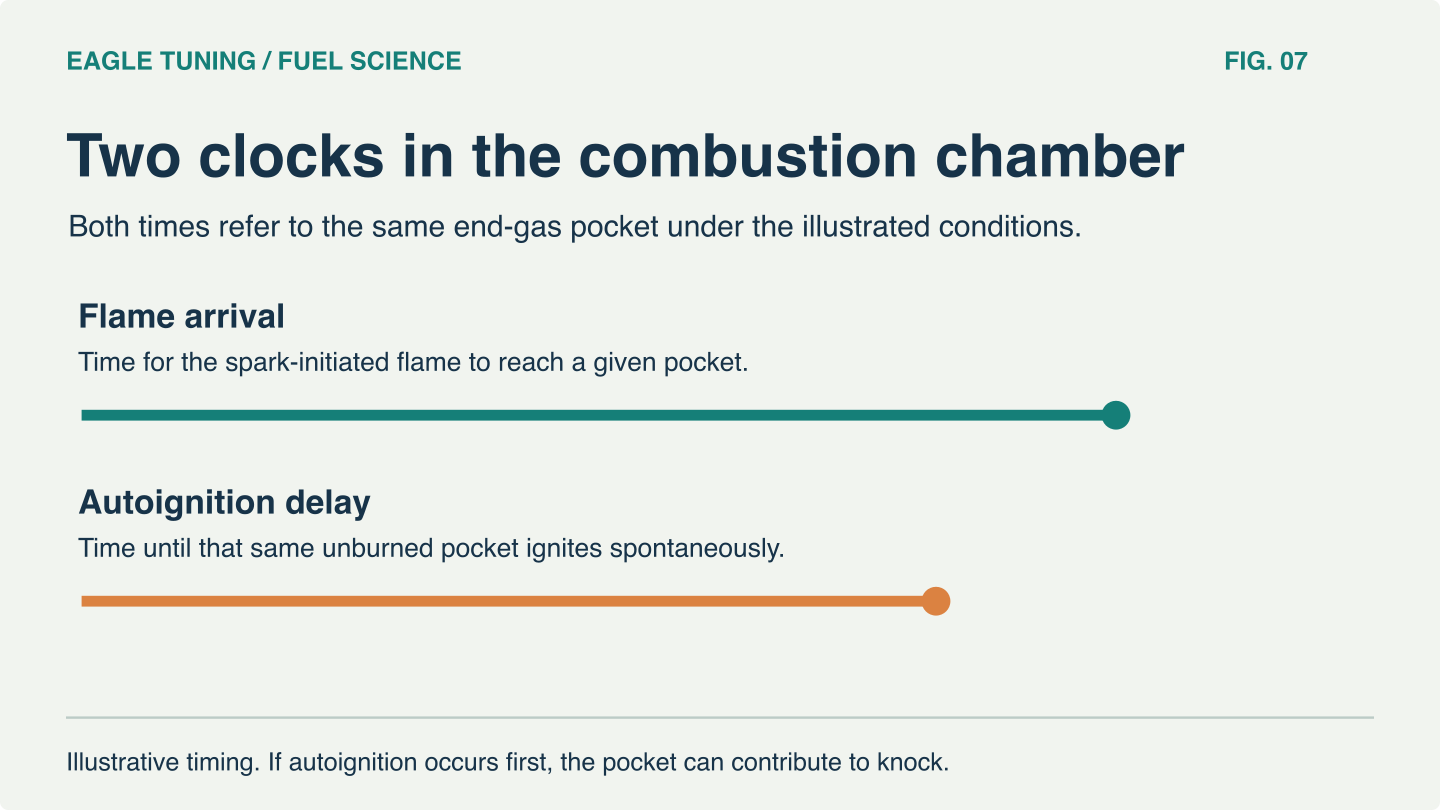
In normal spark-ignition combustion, the spark initiates a flame that travels through the prepared air-fuel mixture. Burning takes time, so the spark commonly occurs before the piston reaches top dead center. As the flame progresses, pressure and temperature rise in the remaining unburned mixture, often called the end gas. Under unfavorable conditions, some end gas can autoignite before the flame reaches it. The resulting rapid energy release and pressure oscillations are associated with knock. Octane testing evaluates a fuel’s resistance to this unwanted behavior under defined conditions; it is not a direct test of horsepower, cleanliness, or energy density.
The end gas is exposed to a changing history of temperature and pressure rather than one fixed “ignition temperature.” Chemical reactions develop during that history, and their rates depend on the fuel composition and engine conditions. Higher load, elevated intake temperature, residual gases, combustion chamber geometry, and ignition timing can all affect the result. Compression ratio matters, but it is not enough to determine a fuel requirement by itself. Two engines with the same geometric compression ratio can have different knock limits because their trapped charge, cooling, combustion duration, and pressure development are different.
Knock and pre-ignition should also be separated. Knock describes unwanted autoignition of end gas in relation to the normal combustion event. Pre-ignition means the mixture begins burning before the intended spark, potentially initiated by a hot surface or another source. Low-speed pre-ignition in some boosted direct-injection engines is a particularly important example of a problem that cannot be solved by treating octane as the only fuel property. Pre-ignition can provoke severe subsequent knock, but the initiating event is different. A high octane label is not a universal guarantee against every abnormal-combustion mechanism.
Octane is often described casually as resistance to burning. That wording is misleading if it suggests that premium gasoline is reluctant to ignite at the spark plug. Normal flame propagation and spontaneous end-gas ignition are different processes. A fuel can resist autoignition while still supporting rapid, stable spark-initiated combustion. It is therefore incorrect to assume that a stock engine cannot “burn” a high-octane fuel merely because its compression ratio is modest. Whether the engine benefits is a separate question involving calibration and the complete fuel specification, rather than an inability to light the mixture.
Ignition timing provides the connection to torque. Advancing the spark generally moves heat release and cylinder pressure earlier in the cycle. Initially that can improve useful work, but there is an optimum range. Minimum spark advance for best torque, commonly abbreviated MBT, identifies the least advance needed to achieve best torque at a particular operating point. More advance beyond that point offers no automatic benefit and can reduce torque or increase stress. A knock-limited engine may be unable to reach MBT on its current fuel; improved knock resistance can then allow operation closer to the preferred combustion phasing.
Consider an illustrative engine operating point where best torque occurs near 18 degrees before top dead center, but the available fuel allows only 13 degrees without unacceptable knock. A suitable higher-knock-resistance fuel may permit recovery of some or all of that five-degree gap, assuming the control system or calibration uses it. There is no universal horsepower value for the recovery. The effect depends on the engine’s torque response to timing at that speed and load. Once the engine reaches its useful timing limit, still more octane does not create a reason to keep advancing the spark.
Modern control systems complicate seat-of-the-pants comparisons. Knock sensors and control strategies may reduce spark advance, alter boost, or otherwise limit torque when conditions demand it. Adaptation may occur over time, and the amount of authority varies between vehicles. Absence of audible pinging is not proof that the engine is running its best calibration or that an unsuitable fuel is harmless. Conversely, one logged timing correction is not conclusive proof of bad gasoline: mechanical noise, temperatures, operating transitions, and the control strategy itself require interpretation. Fuel evaluation needs context and repeated observations.
This explains why higher octane is useful without being universally better. A vehicle designed and calibrated for regular gasoline may already achieve its intended operating targets on that fuel. A performance engine may require premium to maintain those targets, while a modified engine may need a still more specific fuel. The correct choice follows the engine manufacturer’s requirement and, for a modified vehicle, the calibration’s documented fuel specification. “Premium recommended,” “premium required,” and “this aftermarket map requires 93 AKI” are materially different statements. The fuel must match the statement that actually applies to the vehicle.
4. RON, MON, and AKI: Reading the Number Correctly
Research Octane Number, or RON, and Motor Octane Number, or MON, are measured using standardized test procedures in a variable-compression-ratio laboratory engine. ASTM D2699 defines the research method, while ASTM D2700 defines the motor method. The tests use different operating conditions; the conventional research test runs at 600 rpm, while the motor test runs at 900 rpm with a hotter prepared mixture and different ignition settings. MON is usually lower than RON for commercial gasoline. Neither number is a direct measurement of the knock limit in every modern production engine.
The reference-fuel principle makes an otherwise complex behavior comparable. Within the familiar zero-to-100 range, a test fuel is compared with primary reference blends based on n-heptane and iso-octane under the specified procedure. A matching value describes equivalent knock behavior in that test. It does not identify the ingredients of the commercial sample. A fuel with a RON of 95 is therefore not a laboratory certificate stating that the sample consists of 95 percent iso-octane. The percentage interpretation applies to the reference blend used to define this part of the scale, not to the composition of the gasoline being rated.
The scale can extend above 100 because iso-octane’s assigned value is a reference point rather than a physical ceiling on knock resistance. Standardized procedures provide for rating fuels beyond that point using the applicable reference framework. A 110 rating consequently does not mean 110 percent octane, an impossible purity, or 10 percent extra energy beyond a maximum. It means the fuel has antiknock performance above the 100 reference on the stated rating basis. Always retain that last qualification: 110 RON, 110 MON, and 110 AKI describe different numerical claims.
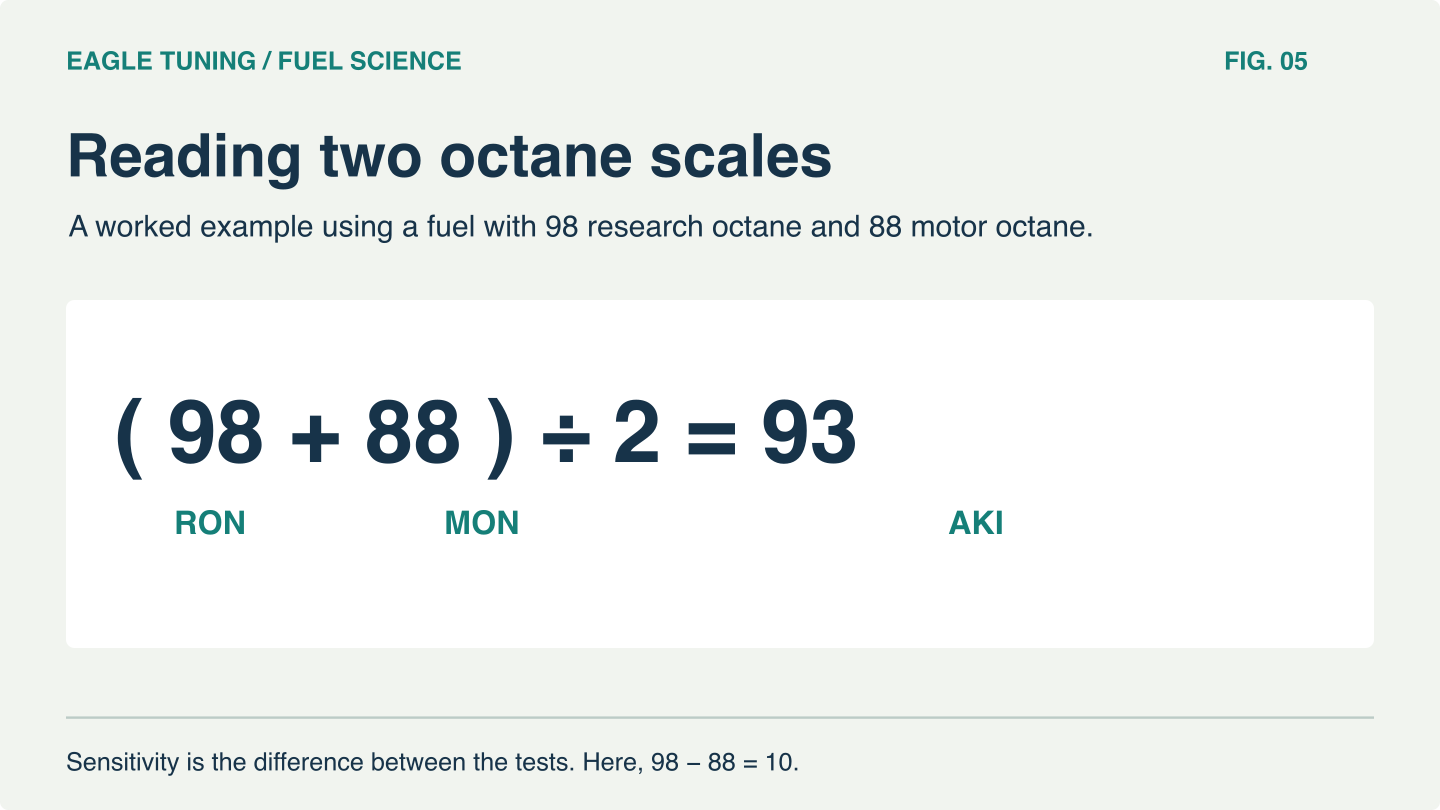
The United States commonly posts Anti-Knock Index, abbreviated AKI. Its definition is straightforward: AKI = (RON + MON) / 2. The familiar pump notation “(R+M)/2” expresses the same arithmetic. Much of Europe displays RON instead. That is the main reason an American pump may show 87, 91, or 93 while a European pump shows 95, 98, or 100. The different labels do not by themselves demonstrate a continent-wide difference in fuel quality. They use different reporting conventions, and actual fuel grades must be compared on the same basis.
| Example fuel | RON | MON | AKI | Sensitivity |
|---|---|---|---|---|
| A | 95 | 85 | 90 | 10 |
| B | 98 | 88 | 93 | 10 |
| C | 100 | 86 | 93 | 14 |
| D | 100 | 90 | 95 | 10 |
These examples answer the common question about European 98 versus American 93. If the 98 RON fuel has a MON of 88, its AKI is exactly 93. If its MON is different, the AKI changes. Conversely, a fuel labeled 93 AKI could have different combinations of RON and MON. Approximate conversion charts are convenient orientation tools, but subtracting a fixed number from every RON rating is not a universal conversion law. A precise comparison needs both test values or a specification that provides enough information about them.
The presence of 91 rather than 93 at an American station reflects the available grade, local supply, and market choices; it does not change the definition of AKI. Nor should a driver assume that the word “premium” guarantees 93 everywhere. Read the posted number, and use the scale required by the vehicle or calibration. A European instruction requesting 98 RON must be interpreted as RON, while an American tune requesting 93 AKI must be interpreted as AKI. A number without its method is incomplete fuel information, especially when vehicles or tuning files move between markets.
The difference between RON and MON is called fuel sensitivity: S = RON − MON. In the table, fuels B and C both have an AKI of 93, yet their sensitivities differ. Sensitivity describes the difference between two standardized test results; it is not simply a rating of quality or consistency. Calling a fuel “more sensitive” does not mean it is unstable in storage. It means its measured antiknock behavior changes more between those two test environments, which can be relevant when trying to understand its performance in another engine environment.
For a more advanced explanation, fuel research often uses an octane index written as OI = RON − K × S. Here K represents the influence of a particular engine operating condition; it is not a universal constant stamped onto the fuel. AKI corresponds mathematically to a weighting of K = 0.5, but a real engine need not behave that way. Published SAE engine research reports conditions with negative K, and later work on modern spark-ignition engines examines why the two standard tests may not bracket actual operation. This is why lower sensitivity is not automatically preferable in every engine.
For the two hypothetical 93 AKI fuels, that framework produces identical index values only at K = 0.5. At other K values their predicted ordering can change. This mathematical example explains how equal pump ratings can conceal different antiknock behavior, but it is not a procedure for choosing a fuel by inventing a convenient K. Establishing the relevant response requires engine data. Evaporative cooling and mixture preparation can introduce further differences, especially when ethanol content changes. RON and MON remain valuable standardized measurements, but neither their average nor their difference describes every aspect of fuel performance.
5. Premium Gasoline, Ethanol, and the Myths Around Them
Premium gasoline is a finished blend formulated to meet a higher stated octane grade. It may contain a different balance of hydrocarbon streams than regular gasoline, and in some markets it may also use a different ethanol concentration. The label does not prescribe one aromatic content, one density, or one detergent concentration. It is possible for two compliant premium fuels to share the same AKI and still differ in RON, MON, ethanol content, volatility, and additive package. Each difference must be considered on its own merits rather than interpreted as proof that one station secretly sells a completely different grade.
Ethanol is useful because it provides strong octane-blending performance. That does not mean every gasoline reaches its final grade simply by adding the same amount to an otherwise identical base. A refiner can formulate a lower-octane hydrocarbon blendstock specifically for ethanol addition, then certify the finished mixture at the desired retail rating. Another fuel may use a different hydrocarbon balance and reach the same rating without ethanol. The finished-fuel test is what matters to the label. Removing ethanol from an existing formulation without redesigning the rest of the blend would not preserve all of its original properties.
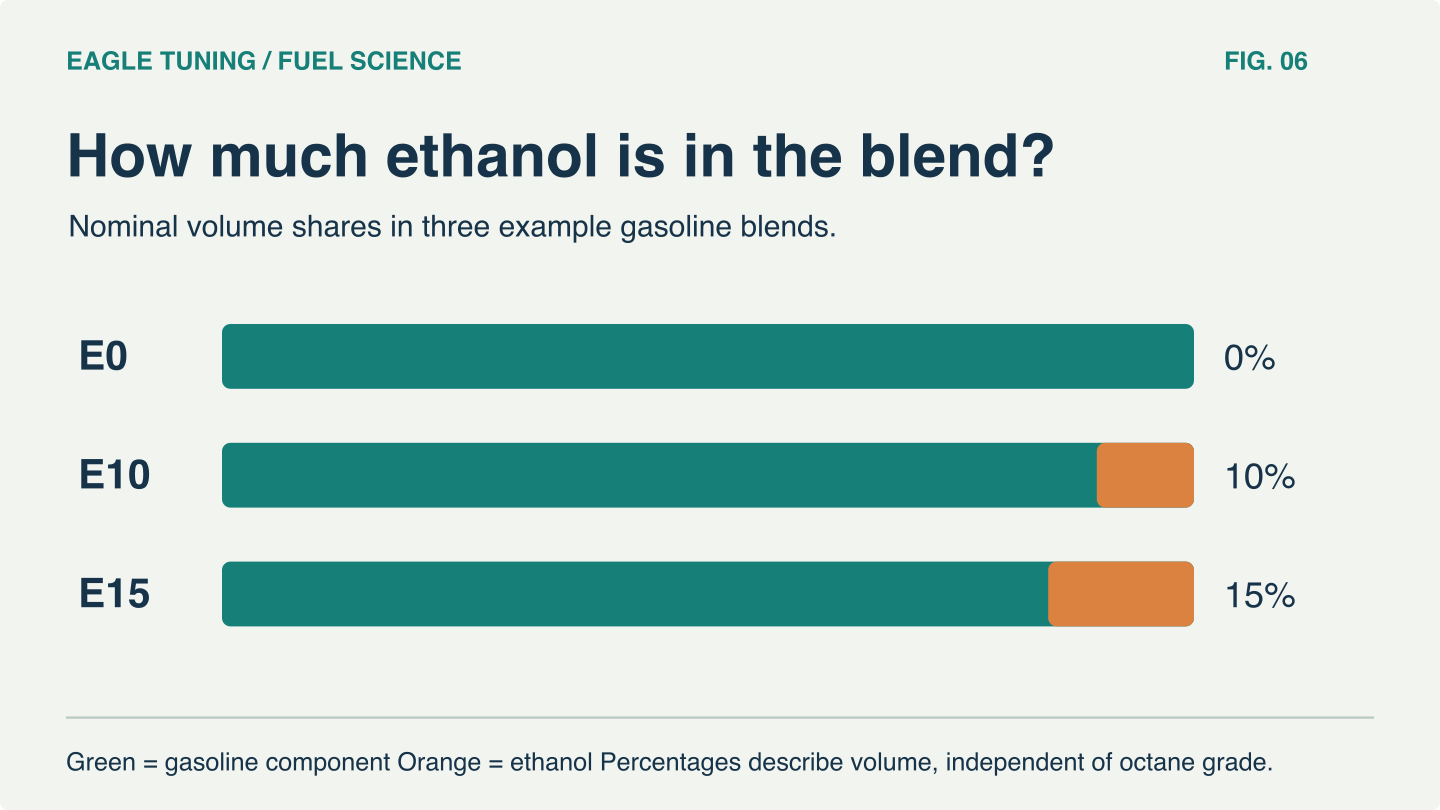
E0, E10, and E15 refer to ethanol content rather than octane. E0 indicates an ethanol-free formulation, E10 conventionally describes gasoline containing about 10 percent ethanol by volume, and E15 commonly describes a blend up to 15 percent. For U.S. regulatory purposes, the Department of Energy’s E15 guidance identifies the E15 category as 10.5 to 15 percent ethanol. These labels do not tell you whether the fuel is 87 or 93 AKI. Read the octane rating and the ethanol labeling separately, and confirm the exact product specification when a calibration depends on a particular ethanol range.
| Label | What it describes | What it does not establish |
|---|---|---|
| E0 | Fuel formulated without ethanol | Octane grade, detergency, or road-use approval |
| E10 | Nominally about 10% ethanol by volume | A universal RON, MON, or AKI |
| E15 | A higher ethanol gasoline blend; U.S. category 10.5–15% | Compatibility with every gasoline-powered machine |
| 93 AKI | An average of research and motor octane values | Whether the fuel is E0, E10, or another permitted formulation |
In the United States, E15 is authorized for conventional light-duty vehicles from model year 2001 onward, subject to the applicable fuel rules. It is not authorized for motorcycles, boats, nonroad engines, or older conventional vehicles. Manufacturer guidance and the requirements of a modified calibration still need attention. A regulatory vehicle category is not a promise that every aftermarket fuel system or tune has been validated on that blend. Seasonal sale requirements and local availability are separate issues from engine compatibility, so they should not be inferred from the ethanol percentage alone.
Yes, 93 AKI gasoline can be ethanol-free. Suitable hydrocarbon components can provide the required knock resistance without an alcohol contribution. Whether a station actually sells such a product depends on supply and the local market; a “recreational” or “ethanol-free” description does not automatically mean 93 AKI. The reverse assumption is equally unreliable: premium does not automatically mean ethanol-free. A driver choosing fuel for a stored vehicle or a sensitive fuel system needs both pieces of information. For a tuned vehicle, changing from E10 to E0 can alter behavior even when the posted AKI remains unchanged.
Energy content helps explain the difference. Ethanol contains less chemical energy per gallon than hydrocarbon gasoline, as described in the Department of Energy’s ethanol overview. A simple illustration uses approximate lower heating values of 32 megajoules per liter for a representative gasoline and 21 for ethanol. Ignoring volume contraction, a 90/10 volume mixture would contain about 30.9 megajoules per liter, roughly 3.4 percent below the gasoline in that example. This is an energy calculation, not an octane calculation, and it is not an exact prediction of a vehicle’s fuel economy.
That lower energy per gallon can coexist with performance benefits in a suitable engine. Ethanol’s evaporation absorbs heat, potentially cooling the intake charge, and its antiknock characteristics can support operating conditions that otherwise would be limited. A calibration may use those properties to run different timing, boost, or compression. The engine then consumes the amount of fuel needed for the desired air-fuel relationship and power. Lower volumetric energy density and greater power potential are not contradictory: one describes the fuel in a container, while the other depends on the engine’s operating strategy and its ability to use the fuel.
The oxygen in ethanol also changes stoichiometric air requirement. A commonly used approximation for hydrocarbon gasoline is around 14.7 parts air to one part fuel by mass, while pure ethanol is around 9:1; actual gasoline blends vary. Lambda expresses mixture strength relative to the specific fuel’s stoichiometric ratio and is therefore more portable between fuels than an assumed gasoline air-fuel number. Injector and pump capacity, cold-start behavior, and control-system authority all become relevant as ethanol content rises. Closed-loop correction at light load does not prove that a high-load calibration is correct for a changed fuel.
Detergents address another property entirely. Their purpose is to control particular deposits, helping preserve the intended behavior of fuel injectors and other affected surfaces. Octane improvers influence knock resistance. A product may contain both kinds of chemistry, but one function does not imply the other. Premium’s higher number does not certify superior deposit control, and an effective detergent package does not turn regular gasoline into premium. The TOP TIER program focuses on detergent performance and requires its approved gasoline additives across all octane grades sold by licensed marketers. A brand may make additional claims for a premium product, but those claims need their own evidence.
Fuel delivery logistics help explain why different stations can sell similar base gasoline but different finished retail products. A shared terminal can supply multiple marketers, with additive packages introduced as part of distribution. Other stations may obtain fuel from different sources, and storage condition, turnover, water contamination, and seasonal formulation can affect the fuel that reaches a vehicle. None of this justifies declaring every brand identical or assuming every independent station is inferior. For performance use, a documented product, a reliable supplier, appropriate storage, and consistent results are more useful than a conclusion based only on branding.
The claim that premium is inherently more powerful confuses knock resistance with energy and calibration. A fuel does not contain a guaranteed extra percentage of usable energy because its AKI is higher. If the engine is knock-limited and can exploit the additional resistance, torque may improve. If its operating targets already are satisfied, the change may produce little measurable benefit. Claims about fuel economy require the same care because energy density, timing, operating conditions, and measurement variation all contribute. A single tank driven in different weather cannot isolate octane as the cause of a mileage change.
Premium also does not inherently burn hotter. Combustion temperature depends on mixture composition, lambda, pressure, heat transfer, and the combustion process. Exhaust temperature adds another layer because ignition timing changes how much energy is released and expanded before the exhaust valve opens. Retarding ignition can raise exhaust temperature in some circumstances even as torque falls. It would be misleading to conclude that the higher exhaust temperature proves the fuel itself has a hotter flame. An octane number is not a thermometer reading or a maximum-temperature specification.
The related statement that premium “burns slower” mixes up flame speed and autoignition delay. Laminar flame speed characterizes a controlled flame under specified conditions. In an engine, turbulence strongly influences the overall burning rate. Autoignition delay concerns the development of spontaneous ignition reactions in unburned mixture. Octane primarily relates to the latter competition under the test conditions, rather than establishing one universal flame-speed ranking. Two fuels can differ in both properties, but their AKI values alone do not tell you which has the faster flame or how many crankshaft degrees combustion will occupy.
Nor is 100-octane gasoline “pure gasoline.” Gasoline is already a blend, so purity is the wrong interpretation. A product labeled 100 can be leaded or unleaded, oxygenated or nonoxygenated, ethanol-containing or ethanol-free, depending on the exact product. Its number also requires a scale. The same reasoning applies to an aftermarket octane booster: the chemical formulation, dosage, base fuel, and test method determine the result. Marketing language about “points” can be ambiguous, so an advertised increase should never be translated into whole AKI numbers without checking exactly what the manufacturer means.
Finally, octane blending is not governed by a universal arithmetic-average law. A volume-weighted average can provide an approximation for some similar fuels, but chemical interactions can make the measured blend depart from that estimate. Ethanol’s blending contribution depends on concentration and the base gasoline; it is not a fixed ingredient number that can always be inserted into a schoolbook average. Sunoco’s technical discussion of mixing explicitly notes nonlinearity in octane and vapor pressure. A precise-looking calculator output is still an estimate unless it uses validated blend data for the actual fuels.
For example, equal volumes of 91 and 93 AKI produce an arithmetic estimate of 92 AKI. That is a useful description of the calculation, not a laboratory certification of the tank. Mixing 93 AKI with a product labeled 100 RON would introduce an additional mistake because the inputs are on different scales. Even when both inputs are AKI, a mixture can change ethanol content, volatility, and hardware compatibility as well as octane. A calibrated engine with little knock margin should use a specified fuel or a validated blend rather than relying on the decimal places in an unverified average.
6. What Sunoco 110 Actually Is—and When Its Properties Matter
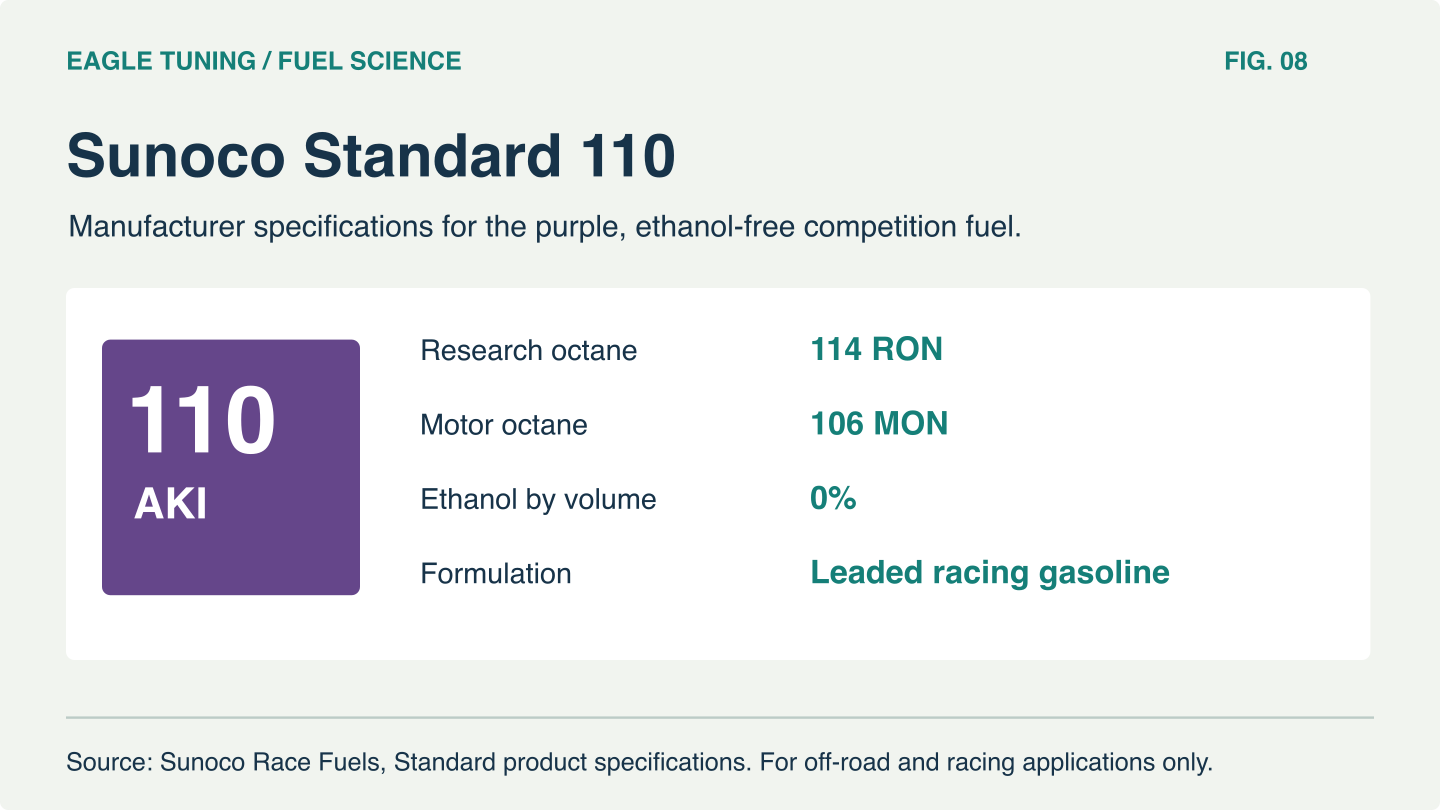
Sunoco Standard 110 provides a concrete example of why a race-fuel specification deserves more attention than the product name. The manufacturer lists it as a leaded, ethanol-free racing gasoline with a RON of 114 and a MON of 106. Their average is 110 AKI, and the difference is a sensitivity of eight. The advertised 110 therefore has a defined mathematical basis. It is not 110 RON, not a percentage of a chemical ingredient, and not a claim that the fuel releases proportionally more energy than 93 AKI pump premium.
| Property | Published value |
|---|---|
| AKI, (RON + MON) / 2 | 110 |
| Research Octane Number | 114 |
| Motor Octane Number | 106 |
| Ethanol, volume percent | 0% |
| Oxygen, weight percent | 0% |
| Leaded | Yes |
| Color | Purple |
| Specific gravity | 0.729 |
| Stoichiometric air-fuel ratio, mass basis | 14.9:1 |
| Lower heating value | 113,400 Btu per U.S. gallon |
Those values are taken from the Sunoco Standard product page; the current product sheet and safety data should govern an actual purchase. The combination is instructive: this fuel reaches a very high octane rating without ethanol, showing that ethanol is one available formulation tool rather than a requirement for all high-octane gasoline. Its published air-fuel ratio also shows why a tuner should not assume one stoichiometric number for everything sold as gasoline. A familiar fuel category can contain products with meaningfully different calibration inputs.
Lead-containing antiknock additives historically provided an effective route to higher gasoline octane. Their presence changes the suitability of a fuel for a modern vehicle. Leaded racing gasoline can damage catalytic converters and oxygen sensors; adding it to unleaded gasoline does not make the resulting mixture harmless to those components. Sunoco’s own fuel-mixing discussion highlights this compatibility problem. Standard 110 is identified by its manufacturer for off-road and racing applications. It should not be presented as a straightforward pump-premium upgrade for a catalyst-equipped road car.
A competition engine may benefit from a fuel like this when its compression, load, chamber design, and calibration require the additional knock margin. But no universal compression-ratio chart can certify the correct fuel for every build. Intake temperature, charge density, cam timing, mixture distribution, combustion duration, and cooling all influence the end-gas conditions. A naturally aspirated engine and a boosted engine with similar static compression can impose very different demands. The engine builder’s requirements and actual test data are more meaningful than choosing a fuel solely because another engine with the same advertised compression ratio used it successfully.
The jump from 93 to 110 AKI is not a horsepower multiplier. Dividing 110 by 93 gives a number, but that ratio has no valid interpretation as a percentage power gain. Octane is a comparative test scale, not a linear measure of available engine output. If the original engine is already at its useful timing and airflow limits, additional knock resistance alone does not supply additional air or command a different torque target. If the build can safely use more load or more favorable combustion phasing, the fuel may enable changes that generate power; the changes and the engine produce the result together.
Switching fuels also requires attention to fuel delivery. Density affects the relationship between delivered volume and fuel mass, while stoichiometric requirement affects the mass needed for a given air charge and lambda. Volatility and distillation behavior influence how the mixture forms and how the engine starts. A carbureted engine may need different metering, and an injected engine may need calibration changes beyond ignition timing. Measuring lambda, fuel pressure, injector utilization, and operating temperatures gives a much more complete picture than simply confirming that knock activity decreased after a fuel change.
Consistency is one reason purpose-formulated race fuels can be valuable. A known product with published properties gives an engine builder a clearer basis for development and repeatability than an undocumented mixture assembled from whatever fuels happen to be available. Storage still matters: exposure to air, heat, water, or unsuitable containers can change the condition of a fuel. A race-fuel label does not cancel basic handling requirements or guarantee indefinite shelf life in a vented vehicle tank. Follow the product’s storage guidance and keep the identity of the fuel traceable when comparing results between events.
For Eagle Tuning readers, the practical sequence is to identify the required rating method, the minimum grade, the permitted ethanol range, and the hardware restrictions before considering a calibration change. Then compare the complete fuel specification with those requirements. A 93 AKI road-fuel calibration, an ethanol-dependent performance calibration, and a leaded race-gas calibration are different operating assumptions. Their labels should not be treated as interchangeable promises. The best fuel is the one whose chemistry, consistency, compatibility, and knock resistance support the intended engine operation—and whose properties the calibration actually understands.