
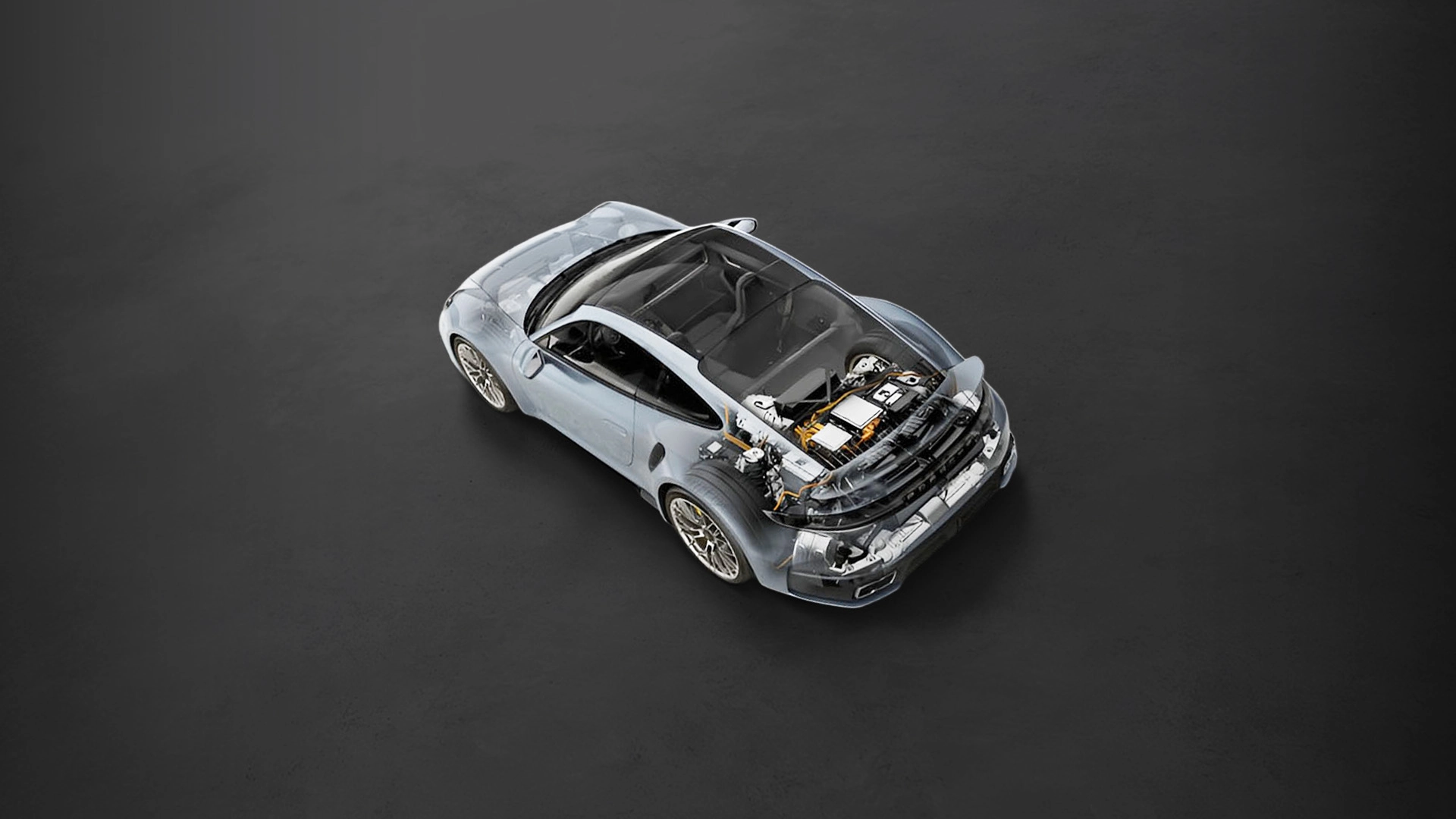
Smart Hybridization: Technology in Service of Performance
Porsche didn’t bolt a battery into the 911 Turbo S to make regulators happy. The whole T-Hybrid system is built around a single question: “How do we make it faster and sharper?”
The compact 1.9 kWh battery doesn’t chase electric range – it feeds two electric turbochargers and support systems instead. For anyone who lives in the tuning world, that’s the interesting part:
instead of fighting turbo lag with small compressors or lazy boost strategies, Porsche uses electric assist to pre-spin the turbos and fill that classic inertia gap.
Result?
Big turbos, instant response
711 hp on tap
Power that feels continuous instead of “wait… and now it hits”
This is hybridization used like a tool, not a marketing trick. Every component is there to improve throttle response, boost control, and overall repeatability – exactly what you want from a platform that’s going to see track time, tuning, and serious use.
Performance Above All: A Gamble That Pays Off in Feel
Any time you add hardware, you risk killing the car’s character. Here, the T-Hybrid setup adds roughly 85 kg, but Porsche claws that back with smarter aerodynamics, better braking, revised chassis tuning, and modern rubber. On road and track, the 911 Turbo S still behaves like a 911 – planted, communicative, and brutally efficient.
More important than the numbers is what the driver feels:
The car reacts earlier to throttle inputs
Boost arrives with less drama and more precision
The chassis is tuned around the extra torque, not scared of it
And the emotional side isn’t ignored. The 3.6-liter Boxer with its asymmetrical timing and new titanium exhaustdoesn’t sound like a muted hybrid experiment. It has depth, texture, and that classic Porsche edge – just with a more modern, aggressive layer on top. The tech fades into the background; what you’re left with is feedback, speed, and confidence.
Conclusion: A Successful Transition, A Lesson for the Industry
The new 911 Turbo S T-Hybrid is exactly what electrification should look like in a performance car:
no apology, no dilution, just a sharper tool.
It proves a simple point the industry keeps forgetting:
if you design hybrid systems around driving pleasure, they don’t kill the soul – they amplify it.
Instead of chasing meaningless EV range or marketing buzzwords, Porsche used electric power to solve real dynamic problems: response, lag, consistency. The car is quicker, more capable, and still unmistakably a 911.
For the rest of the industry, this is the lesson:
don’t ask, “How do we make this car hybrid?”
Ask, “Where does electrification actually make the driver faster, smoother, and more in control?”